
 Translate
Judge Mark Larrañaga - Superior Court
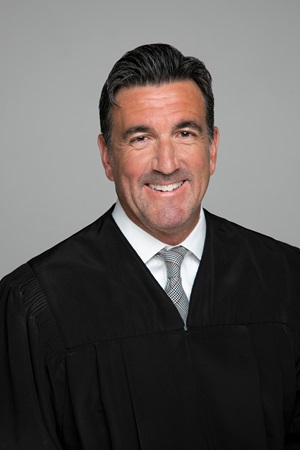
• Courtroom Number: E-746
• Bailiff: Bren Smith
• Department: 33
• Assignment: Civil
Biography- Judge Mark A. Larrañaga
After thirty years of trial and appellate experience, Judge Mark A. Larrañaga was appointed to the King County Superior Court bench on May 7, 2023, by Governor Jay Inslee. Judge Larrañaga is currently assigned to both the unlawful detainer calendar and civil trial rotation at the King County Courthouse in Seattle, Washington.
From 1993-2001, Judge Larrañaga worked as a public defender at The Defenders Association in King County. He tried cases ranging from misdemeanors to capital aggravated murder.
From 2001- 2005, Judge Larrañaga was the director of Washington state’s first death penalty resource center, which provided training, education, and assistance to attorneys assigned to capital cases. He authored reports and testified before the Washington State legislature on different aspects of Washington’s death penalty system.
From 2005-2023, Judge Larrañaga worked primarily on capital cases in state and federal courts. He also handled capital and non-capital appeals before the Ninth Circuit Court of Appeals, Washington and Oregon State Supreme Courts, and all three divisions of the Washington’s Court of Appeals. He was deemed “learned counsel” in state and federal courts for appointment on capital trials and appeals in Alaska, California, Colorado, Idaho, Oregon, and Washington.
From 2005 – 2018, he taught a course on capital jurisprudence at Seattle University School of Law and co-authored An Analysis of the Economic Costs of Seeking the Death Penalty in Washington State, Seattle Journal for Social Justice, Vol. 14, Issue 3, Spring 2016.
Since his appointment to the bench, Judge Larrañaga has presided over criminal and civil cases, and has been either chaired, co-chaired, or a committee member to King County Superior Court’s (KCSC) Executive Committee, KCSC Jury Committee, KCSC Education Committee, Administrative Office of the Court’s (AOC) Childcare Support Workgroup, Washington State Bar Association’s (WSBA) Council on Public Defense, WSBA Access to Justice Gap Work Group, and Superior Court Judges Association’s (SCJA) Criminal Rules and Law Committee.
Biography- Bailiff Bren Smith
Bren began her professional career in the justice system in 2011 after graduating with Honors from Kaplan University with a Bachelor of Science in Judicial Administration with an emphasis on Organizational Innovation. She served with the King County Department of Judicial Administration from 2011 to 2020 as a Courtroom Clerk and Legal Administrative Specialist, providing comprehensive courtroom support across criminal and civil proceedings, Family Law, Drug Court, At-Risk Youth, and Involuntary Treatment Act (ITA) calendars. In addition to her courtroom responsibilities, Bren demonstrated a strong commitment to equity and inclusion, serving as a member, Secretary, and ultimately Chair of the Department’s Equity, Social Justice & Diversity Committee.
In 2020, Bren was appointed Bailiff to the Honorable Judith Ramseyer (Ret.), serving in that role until Judge Ramseyer’s retirement in 2023, after which she joined Judge Larrañaga upon his appointment to the bench. During the summer of 2020, Bren co-developed an innovative electronic juror questionnaire system that enabled King County Superior Court to safely continue jury trials during the COVID-19 pandemic. She has also served as a member and Co-Chair of the Bailiff Education Training Committee, a member of the Jury Committee, and currently serves on the Diversity, Equity, and Inclusion Committee.
DO NOT email the judge directly. All email correspondence must go through the bailiff. Please see the email address listed above.
Please see this link for King County Superior Court’s policies regarding emailing with the court.
Rules to Review before Emailing or Calling the Court
- Ex Parte Procedures - King County Local Rule 40.1
- Procedures for motions without oral argument- King County Local Rule 7
- Revision and Reconsideration- King County Local Rule 7
- Trial Continuance- King County Local Rule 40
- Summary Judgments- Civil Rule 56
- Motions to Dismiss- Civil Rule 12
- Motions to Set Aside Judgment- Civil Rule 60
- Motions for Order Compelling Discovery- King County Local Rule 37
- Motions to Shorten Time- KCLR 7(b)(10)
- Motions to Seal- LGR 15
Civil Case Information, Forms, and Documents
Contact the Clerk's Office for information regarding individual civil cases. The main information desk can be reached by calling 206-296-9300.
- For civil calendar information, check the Civil Standby Calendar and the Clerk's Office Directory of Court Calendars.
- Civil Court Forms are available both online and from the Clerk’s Office.
- Learn how and where to file your court documents and how to get copies of court documents or recordings of proceedings.
Notice Regarding E-Service Requirement
-
Pursuant to Local General Rule 30, all attorneys and unrepresented parties who E-file documents must register to accept e-service via the Clerk’s e-Filing application, unless they have been granted a waiver. IF YOU FAIL TO REGISTER FOR E-SERVICE, IT IS POSSIBLE YOU WILL NOT RECEIVE A COPY OF A COURT ORDER.
Electronic Working Copies
Judge Larrañaga prefers to receive electronic working copies submitted to the Clerk using the Clerk’s e-Filing Application pursuant to LCR 7(b)(4)(F)(i).
Please note: If you cite materials previously filed within the court record, please reference the document by title and sub number (i.e.: Declaration of Bob Jones, Sub/Dkt. #5).
If a party’s submission exceeds the 500-page limit, you may request prior permission from Judge Larrañaga’s bailiff to deliver the working copies in PDF format, either on disk or thumb drive (and delivered to the Judge’s Mailroom). Prior permission should be requested by sending an email to larranaga.court@kingcounty.gov. Please do not email any working copies directly to the Court or to her bailiff without prior permission. Please put in the upper right corner of the working copies the note date of consideration or hearing, Judge Larrañaga’s name, and by whom the documents are being presented (“moving party,” “opposing party,” or other descriptive or identifying term).
Non-Dispositive Motions
Parties must comply with all the requirements of KCLR 7 when setting motions without oral argument, including providing and filing proof of service of the motion. Non-dispositive motions will be considered by the Court without oral argument unless requested and the Court agrees oral argument is necessary. To request oral argument, please indicate on the front page of your motion or opposition. If oral argument is necessary, the bailiff will contact the parties regarding scheduling. When oral argument is not necessary, you will receive a courtesy copy of the Court’s order on the non-dispositive motion once the court enters a ruling
Unlawful Detainers
If you need to schedule a hearing on an unlawful detainer (eviction) matter, please email larranaga.court@kingcounty.gov to obtain a date for your hearing.
Dispositive Motions and Other Hearing Requests
- Judge Larrañaga’s motion with argument calendar is available to view below. Dispositive motions are heard on Fridays. Other hearing types, such as preliminary injunctions, revisions or criminal motions are generally scheduled in no more than 30-minute time slots Mondays – Thursdays, and occasionally on Fridays. Please send an email to larranaga.court@kingcounty.gov for scheduling of motions with argument.
- Dispositive motion hearing times are available in one-hour slots, which are noted as “DISPOSITIVE MOTION TIME AVAILABLE” on this calendar.
- Motions are allotted 1 hour for argument and ruling. Cross-motions or additional (separately briefed) dispositive motions must also be scheduled with the Court. You may not include those as part of your response to a motion. Please advise the bailiff if the parties are seeking additional time on hearings involving multi-parties or complex issues.
- Working copies, per LCR 7(b)(4)(F), of the parties’ briefs and accompanying documents must be submitted through either e-working copies, or as otherwise authorized by the Court. Working copies must be submitted when they are due to be filed. Do not wait to submit until the reply is due.
- If the moving party elects for any reason not to proceed with the motion, that party shall notify the court to strike the hearing immediately, per KCLCR 7(b)(4)(H).
- Please select a date from this calendar and then check with all opposing counsel or pro se parties to make sure that the date works before contacting the bailiff, as this is required. Doing so reduces the need to reschedule hearings due to conflicts. The court will not schedule the motion unless all parties have indicated they are available.
- Once you have selected a date and confirmed all parties’ availability, you must contact the bailiff to confirm the date is still available. DO NOT note your motion until the bailiff has sent back confirmation. Email requests must include the following:
- Case name and cause number
- Names and email addresses for all counsel and/or pro se parties involved in the case
- Type of hearing and date(s) requests from the available dates on the calendar below
- The Court requires that you file and provide a working copy of your Note for Motion within 48 hours after confirming a hearing date. Per LCR 7(b)(4)(F), the parties are required to provide working copies in support of or opposition to the noted motion no later than the day they are to be served on the opposing party.
Family Law Resources
Access a list of General Family Law Resources for low-cost assistance with family law matters. For parties navigating a dissolution, please refer to the How-to resources for Family Law page. For parties without an attorney, please review the services provided through the Family Law Facilitators - King County. They are a wonderful resource to answer questions on how to navigate through your case to resolution.
Settled Cases and to Strike a Motion
Please email the bailiff immediately if a case settles or if you wish to strike a motion you have filed from the court’s calendar. Trial courts are not notified when a case otherwise resolves through the ex parte department, or when a Notice of Settlement is filed within the Court record.