
 Translate
In response to community feedback, Public Health is making big changes to the proposed update for the Vashon-Maury Island Marine Recovery Area (MRA). As part of this process, we will work with community members to develop a plan to have septic systems across the island inspected to meet state law requirements. We are no longer proposing to include all shoreline properties.
Vashon Island is known and loved for its connection to the environment. Thank you to everyone who has thoughtfully engaged on this topic to protect people’s health and the environment, and we look forward to continuing to work with you on next steps.
Stay updated and get more information
- Sign up for regular email updates: Marine Recovery Area updates
- Register for a community meeting: November Vashon MRA Community Meetings (Nov 7, 13, 16, 19)
- Meet Public Health staff on the island to discuss questions and answers:
- Tuesday, October 27, 2026, 10 am to 2 pm at Vashon Chamber of Commerce, 17141 Vashon Hwy SW #101, Vashon, WA 98070.
Sign up for the Q&A hours (not required but encouraged).
- Tuesday, October 27, 2026, 10 am to 2 pm at Vashon Chamber of Commerce, 17141 Vashon Hwy SW #101, Vashon, WA 98070.
MRA update status and related septic planning
We are planning to significantly reduce the number of properties included in the MRA expansion. We are currently evaluating which properties directly align with specific criteria outlined in chapter 70A.110 RCW. This would include about 75 additional properties, instead of all properties on the shoreline. This expansion would be focused in areas where pollution risk is greatest. We will base this change on additional review of data, further legal analysis, and discussions with the Washington State Department of Health and other local health jurisdictions.
State law requires that all septic systems get inspected at least every three years. Public Health is required to create a plan to get septic systems in high-risk pollution areas inspected as part of the Local Management Plan update process.
We want your input on this plan, including:
- Which areas have the highest risk and impact
- Financial assistance for maintenance and repairs
- Technical assistance for challenging lots
- Self-check inspection pilot program
- Phased implementation of septic inspection reminders and enforcement
- Training for property owners to coordinate group inspections
- Resources on how to work with service providers
What does the proposed expansion mean for me?
Properties in the updated MRA will be required to have their septic system inspected by a certified maintainer within 3 years of the expansion and continue to have inspections as frequently as determined by the MRA development process (see more information below). By making sure that septic systems are inspected, small problems can be fixed before they get more expensive.
A process will be established for property owners to request exemption if it can be clearly established that their septic system does not present a risk of direct discharge to the shoreline.
Public Health will provide septic system maintenance and financial assistance information to all property owners in the MRA.
How has the MRA helped improve water quality?
Water quality has consistently improved since the MRA was created, which is largely due to homeowner’s investment in septic maintenance. We use commercial shellfish harvest classifications as one way to understand water quality. The below graph shows the number of acres reclassified as approved for shellfish harvesting around VMI as a result of septic maintenance efforts throughout the years since MRA was implemented. The labels (e.g. “Outer Quartermaster Harbor MRA”) highlight specific septic maintenance efforts that resulted in the acres being approved.
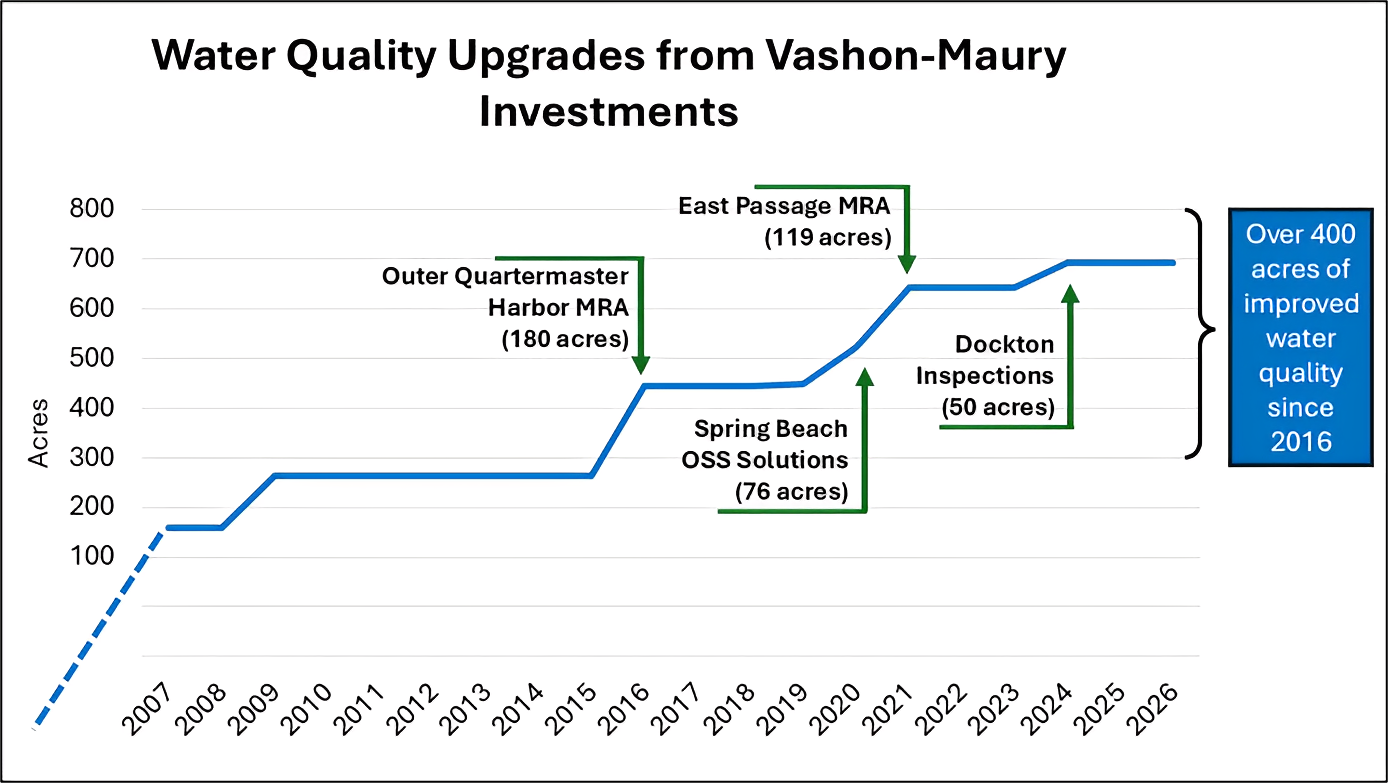
Accessible version of the above graph: Water quality upgrades from Vashon-Maury investments (Over 400 acres of improved water quality since 2016)
-
2016
Outer Quartermaster Harbor MRA (180 acres)
-
2020
Spring Beach OSS Solutions (76 acres) -
2021
East Passage MRA (119 acres)
-
2024
Dockton inspections (50 acres)
Frequently Asked Questions
In 2006, state law required Puget Sound counties (including King County) to designate MRAs where shellfish growing areas are closed due to bacterial pollution from septic systems, if closure is likely, or where bacteria or nitrogen are seriously affecting water quality. The MRA in King County was established because parts of Vashon-Maury Island were closed for commercial and recreational shellfish harvesting.
During the inspection, a septic system maintainer will find the distribution box, inspect the drainfield by walking over it, look at fixtures and pipe conditions, and any signs of failing. After, an inspection report will be submitted, and homeowners can track their septic system performance in online reports.
Yes, an initial MRA inspection will be more thorough to find information about the septic system if we don't already know that information. The septic system will be located and a dye test completed to check whether all plumbing is connected to the septic system, which makes sure there isn’t surfacing effluent in the drainfield or shoreline. A stress test will also be conducted, which involves running water through the system to see how it flows and if there are any issues. After this initial inspection, on-going routine inspections focus on looking at each component of the system to ensure wastewater is treated properly through the system.
A septic system inspection usually costs $300-400. The OSS Maintenance Rebate Program is available to help with inspection costs. Septic system repairs and replacement costs vary widely. Some fixes are simple and only cost a few hundred dollars. If a new septic system is needed, this usually costs $40,000-50,000. Financial assistance is available for these costs too.
A property owner may request an exemption to MRA inspection requirements if the property meets the following conditions.
- Initial MRA inspection shows that OSS is operating as designed without deficiencies
- Approved OSS record drawing exists
- OSS is over 100 feet from the shoreline
Public Health will evaluate the exemption request to determine if the risk of sewage discharge to the beach is low.
When septic systems don’t fully treat sewage, germs in wastewater flow through the soil on properties and onto the beach. These germs can then get sucked into filter-feeding shellfish or be swallowed by kids who are swimming, causing people to get sick.
Through our work on the VMI shoreline, we have consistently found failing septic systems that cause higher levels of bacteria in the water flowing onto the shoreline.
We use two different tests to help track where bacteria are coming from. We test for bacterial DNA that is only present in the human gut to help us confirm that it is from a human source. Next, we do a dye test in which different colored dyes are added to different septic systems. If a color shows up in the polluted water, it shows us which septic system is contributing to the pollution.
The first step is to know where your septic system is located. You can find your property’s record drawing on the Septic Records Search. Make sure you put only human organics, toilet paper, and a small amount of chemicals or food scraps down the drain. Spread out water usage by doing laundry and running dishwasher at different times. Lastly, learn about local septic resources and opportunities like Vashon Team Septic (Septic Sisters) and the Septic Self-check pilot program.
Current Marine Recovery Area Maps
Current MRA detailed maps show the individual parcels within each section of the MRA. The individual parcels are color-coded to show the level of information available in the Public Health—Seattle and King County records. This color-coding is done for each on-site sewage system. View the map legend for details.
Quartermaster Harbor Maps from north to south
- Governor's Lane, Section A (294 KB)
- Governor's Lane, Section B (322 KB)
- Shawnee-Magnolia Beach (450 KB)
- Harbor Heights, Section A (419 KB)
- Harbor Heights, Section B (343 KB)
- Tahlequah 125th PL SW areas (323 KB)
East Passage maps from north to south
- Dolphin Point (324 KB)
- Glen Acres (338 KB)
- Hawthorne (320 KB)
- Klahanie (318 KB)
- Summerhurst (350 KB)
This project has been funded wholly or in part by the United States Environmental Protection Agency under assistance agreement PC-01J89801-1 to the Washington State Department of Health. The contents of this document do not necessarily reflect the views and policies of the Environmental Protection Agency, nor does mention of trade names or commercial products constitute endorsement or recommendation for use.