
 Translate
RapidRide K Line
Coming to Kirkland and Bellevue
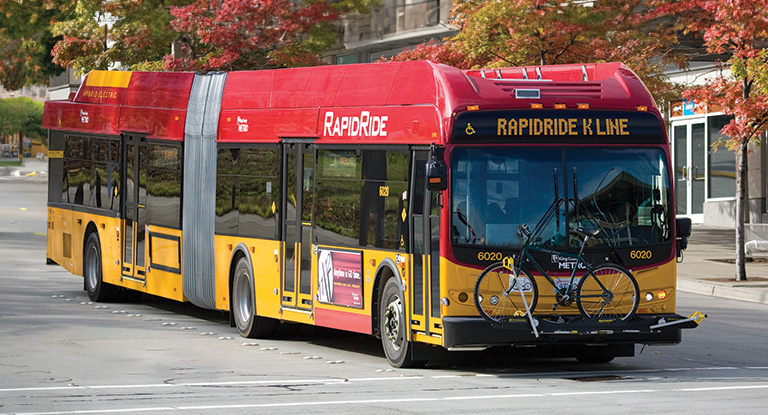
Metro is working to bring new RapidRide service to the Eastside, to provide better, more reliable bus service to communities in Kirkland and Bellevue. By fall 2030, Metro plans to bring RapidRide K Line to the fast-growing communities between Totem Lake Transit Center, downtown Kirkland, downtown Bellevue and the Eastgate Park-and-Ride.
Project overview
Metro is advancing design of the RapidRide K Line, a new bus rapid transit corridor planned to connect communities in Kirkland and Bellevue by 2030.
The RapidRide K Line will serve a 16-mile north–south corridor linking key destinations including:
- Totem Lake Transit Center
- Downtown Kirkland
- South Kirkland Park & Ride
- Downtown Bellevue
- Bellevue College
- Eastgate Park & Ride
The project will provide fast, reliable transit service while improving connections to regional transportation and community destinations across the Eastside.
The RapidRide K Line project will improve transit travel time, reliability, and rider experience.
Recommended Improvements include:
- Upgraded transit stations and shelters
- Enhanced lighting and passenger amenities
- Faster all-door boarding at stations
- Transit priority treatments
- Signal upgrades to reduce delays
- Safer pedestrian access to transit
- On-street bike lanes and raised bike lanes at station platforms
RapidRide K Line will strengthen connections to the expanding regional transit network. Including:
- Sound Transit Link light rail
- Sound Transit Stride bus rapid transit
- Existing RapidRide routes
- Regional trail systems such as Eastrail and the SR 520 Trail
These connections will help riders travel more easily across the Eastside and the greater Puget Sound region.
RapidRide K Line will build on transit service already operating in the corridor. The new service pathway covers portions of several existing routes currently serving the area:
- Route 239
- Route 245
- Route 250
- Route 255
- Route 271
Together, these routes currently carry approximately 12,505 average weekday boardings. (Data as of February 2026)
Metro followed the Federal Transit Administration’s (FTA) methodology, called FTA Warrants Justification, to document existing transit ridership along the proposed RapidRide K Line and to justify the capital investment. In spring 2024, the average weekday ridership was over approximately 6,800 riders on the routes that will become the future RapidRide K Line. Projects with a total capital cost from $60 million to $120 million need approximately 4,200 transit riders to justify investment from the Federal Capital Investment Grants (CIG) program.
Metro plans to conduct community and jurisdictional engagement to restructure bus service around Metro’s RapidRide K Line and Sound Transit’s Stride I-405 BRT. The restructure aims to make the best use of the significant investments in the K Line, enhance the integrated transit network and increase efficiency by reducing service duplication.
Metro is applying for multiple federal and state grant programs to supplement local funding for the project.
Metro submitted a Small Starts Grant Application (SSGA) to the Federal Transit Administration (FTA) in August 2025. The project received a rating which would make it eligible for federal funding in fiscal year 2027.
Project goals
Metro developed RapidRide K Line with community and jurisdictional partners to:
- Connect jobs, housing and Eastside communities to regional transit, including Link light rail, Stride S1 and RapidRide B Line.
- Provide faster, more reliable service with increased frequency and upgraded stations.
- Improve access to major employment centers, schools, housing, and regional transportation.
- Reduce greenhouse gas emissions by increasing transit ridership.
- Deliver the project through a partnership with the Federal Transit Administration’s Small Starts Grant program.
Timeline
This timeline is updated as the project progresses so you can quickly see where the project stands now, what has been completed, and what comes next.
Needs Assessment
Project vision and early planning
Metro began planning RapidRide K Line after the adoption of Metro Connects, King County’s long-range plan for expanding frequent transit service. This phase established the project vision and laid the groundwork for future corridor planning, funding and community engagement.
What happened in this phase
- Metro Connects identified RapidRide expansion as a long-term priority.
- King County Council actions and budget approvals established K Line as an early RapidRide project.
- Conceptual planning work began in coordination with transit planning in Kirkland and Bellevue.
- The project paused during the COVID-19 pandemic and resumed with updated planning work.
- Metro advanced the project toward route adoption and federal funding review.
Community engagement
Phase 1: In Fall 2019, Metro began engaging community members, businesses, service providers, and community-based organizations (CBOs) in Kirkland and Bellevue to understand their transit needs and priorities, and to gather input to inform the design of RapidRide K Line. Metro was looking for specific feedback to determine route options between Totem Lake, downtown Kirkland, and the South Kirkland Park & Ride. Community engagement activities consisted of interviews, in-person engagement and online surveys. The report below summarizes the results of this engagement.
Summary reports
Planning Phase
Early design
During the Planning Phase, Metro refined the RapidRide K Line corridor, evaluated potential improvements, and worked with city partners and the public to shape the recommended project. This phase concluded when the Locally Preferred Alternative was adopted.
What happened in this phase
- Metro evaluated route options, corridor needs, and potential improvements.
- Project concepts were refined using technical review and public feedback.
- Metro coordinated with Bellevue and Kirkland on project priorities and support.
- The recommended project was documented through the Locally Preferred Alternative process.
- King County Council adopted the project direction, allowing the project to advance into design.
Community engagement
Phase 2
During the summer, Metro reintroduced the project and gathered feedback on community priorities and plans for RapidRide K Line which were developed in partnership with local agencies to address project and agency goals.
Phase 3
In the winter, Metro reported back to key partners and community members who participated in prior phases of engagement to share the updated concept for the RapidRide K Line and confirm it continues to meet the community needs and priorities.
Summary reports:
Design Phase
Turning the project into a buildable plan
The Design Phase will further develop and refine the project recommendations from the Locally Preferred Alternative.
What happens in this phase
- Environmental impacts are assessed
- Station placement at the identified service intersections is further refined.
- Speed & Reliability treatments are further developed for implementation.
- Access to Transit Concepts are designed to provide enhanced access for cyclists and pedestrians.
- Project designs are evaluated for utility conflicts, property impacts, and overall constructability.
- Project Cost estimates are further developed to match the approved budget.
Design phase milestones
Metro expects to share updates at four major design milestones. Each milestone can show what has been refined, what the public is seeing, and what comes next.
30% - Preliminary design
Updated May 4, 2026
At 30%, Metro can show the project at a preliminary design level. This is where the adopted concept begins to take clearer physical form.
Typical focus at this milestone
- Early station and corridor layouts
- Preliminary review of utility and property impacts
- Initial cost and feasibility refinement
- Public introduction to early design direction
- Early real estate evaluation activities, including requesting title reports, reviewing surveys for property features and impacts such as utilities, and identifying right-of-way constraints
60% - Final design
At 60%, all project decisions are resolved and the project team can show how station designs, stop locations, corridor treatments, and technical coordination have evolved since the preliminary phase. This is often the best point to explain what changed and why.
Typical focus at this milestone
- Refined station layouts and corridor concepts
- Updated technical coordination and design detail
- Clearer explanation of changes since 30% design
- Public-facing visuals that show project refinement
- Identify potential vehicular and non-vehicular access issues to surrounding properties
- Begin to advance property owner outreach for potentially impacted parcels
What improvements riders will see
- Integration into existing environment: How will the design be incorporated into the existing roadway and trail system. Where will there be new sidewalk improvements, drainage improvements and access to local businesses and residences.
- Required utility work: At this level of design, nearly all required utility work will be identified and discussions about relocations will begin.
90% - Final Design
At 90%, the project design is nearing completion and most details needed for construction have been finalized. This milestone provides one of the clearest views of what the community can expect to see when construction begins.
Typical focus at this milestone
- Construction readiness messaging
- Continue to advance property owner outreach for potentially impacted parcels
- Preparation for pre-construction communications
What improvements riders will see
- Permitting requirements: Incorporation of permitting requirements from the cities of Bellevue and Kirkland into designs.
100% - Final Design
At 100%, the project is ready for bid advertisement and pre-construction to begin.
Typical focus at this milestone
- Transition into pre-construction activities
- Updated expectations for the next project phase
- Clear bridge from design to construction communications
- All property acquisitions should be complete to avoid construction impacts
What improvements riders will see
- Final finishes: Project sponsored art, landscaping design and other final products will be determined.
Construction
Preparing for and building the project
In this phase, Metro can explain what happens after final design and before visible construction begins. The focus shifts from design development to implementation readiness.
What may happen in this phase
- Permit coordination and agency approvals
- Early utility work or advance preparation
- Construction planning and procurement steps
- Public information about what to expect before work begins
Construction
Building corridor and station improvements
During construction, the page can focus on what is happening in the corridor, where work is occurring, and what nearby riders, residents, and businesses should expect.
What users may need during this phase
- Construction schedule and major work windows
- Travel impacts and temporary changes
- Station construction updates
- Business, neighborhood, and rider information
Start of Service
Launching RapidRide K Line service
This phase can celebrate the project opening and shift the page toward rider information. At that point, the focus becomes how to use the service and what customers need to know on day one.
What users may find in this phase
- Service launch information
- Station and rider amenities
- How to ride and service highlights
- Links to schedules, maps, and rider tools
Sign up for project updates
New subscribers
Get project updates and announcements about events and milestones. To subscribe, enter your contact information. To receive both email and text alerts, you'll need to sign up twice.
Current subscribers
To manage your preferences or unsubscribe, enter your email or mobile number.
FAQ
Metro submitted a Small Starts Grant Application (SSGA) to the Federal Transit Administration (FTA) in August 2025. In April 2026, Metro was notified their project submission received a “medium-high” project rating for fiscal year 2027. With this project rating, RapidRide K Line is eligible to receive federal funding in the future, when funds are made available and the project is ready for construction.
Project notifications were sent to landowners along the K Line route during Phase 2 and Phase 3 of community engagement.
During Preliminary design, if property impacts are identified, the property owner will be contacted. If property owners are not contacted, it means there is no planned impact to the property. No matter the impact level, all property owners along the route will continue to receive project notifications throughout the project lifecycle.
During the initial design phase, if the project team identifies a right-of-way need, the property owner is contacted directly by Metro (with support from city partners). Property owners can participate through the larger community engagement process and impacts to their property are not decided without a Metro conversation. Metro plans to identify these property impacts during the preliminary design phase.
During the Small Starts Application process, Metro applied for and received a justification warrant from FTA. The justification warrant uses existing corridor ridership to justify project funding. Current boardings along the proposed K Line route equaled 6,800 average daily boardings (data from spring 2024).
Existing transit routes on the Eastside, which overlap with portions of the proposed K Line route, totaled over 12,000 average daily boardings (data from February 2026).
The projected travel times with proposed improvements for the K Line are 68 minutes for northbound travel (from Eastgate Park-and-Ride to Totem Lake Transit Center) and 70.1 minutes for southbound travel (from Totem Lake Transit Center to Eastgate Park-and-Ride).
By comparison, corridor travel times without any proposed improvements would be 88.5 minutes northbound and 96.5 minutes southbound.
Note: the travel times reported above are for the weekday afternoon/evening peak hours, which is typically 3pm to 7pm.
The new RapidRide K Line route will include a restructure of surrounding transit service. This restructure will include a separate engagement process with city partners and community, in order to identify potential changes to the transit network to best meet community needs. A service restructure will aim to reduce duplication of service and deliver a unified transit network that will maximize frequency, coverage area and timely connections to other regional transit service.
The project budget will, at a minimum, meet King County standards for bus rapid transit and county adopted RapidRide 2.0 standards to deliver a service which is fast, reliable and frequent.
Project improvements will include:
- Upgraded station platforms and rider amenities
- Sidewalk, bike lane, and safe crossing improvements to enhance access for riders to transit stations
- Transit priority treatments to ensure fast, reliabile and frequent RapidRide service. Treatments may include: Business Access and Transit Lanes, Bus-only Lanes, Transit Signal Priority (TSP), Queue Jumps and upgraded signal timing.
Metro applied for a 49% funding match from CIG (Capital Investment Grants) funds. The cost of operation is not included in the project budget and new buses will not be purchased.
Resource library
Community Engagement Summary (Winter 2025)
A detailed 156-page report summarizing the engagement conducted from January to February 2025 during the final part of the planning phase.
Community Engagement Executive Summary (Summer 2024)
A shorter, 5-page overview of the full summary report.
Community Engagement Summary (Summer 2024)
A detailed 100-page report summarizing the engagement conducted from June to July 2024 during the early planning phase.
Community Engagement Summary (Fall 2019)
Provides a summary of the engagement conducted from September to December 2019 during the needs and priorities assessment.
RapidRide K Line Fact Sheet (Spring 2024)
A summary of the RapidRide K Line project during the early design phase, including the proposed route, project benefits, timeline and opportunities for public input.
RapidRide K Line Fact Sheet (Winter 2025)
An updated summary of the RapidRide K Line project reflecting the Locally Preferred Alternative and the transition into preliminary and final design, including the latest project timeline and planned improvements.
FTA Project Justification Warrants (July 2025)
The Project Justification Warrants documents RapidRide K Line's qualification for project warrants, which demonstrates a projects funding eligibility based on existing corridor ridership. The letter documents the ridership methodology and RapidRide K Line's eligibility under the current Capital Investment Grants (CIG) Policy Guidance.
Task 120: Speed and Reliability (April 2025)
A report detailing the transit priority (Speed & Reliability) projects evaluated during the Planning Phase for RapidRide K Line.
Task 130: Passenger Facilities (April 2025)
A report detailing the considerations for transit stations (Passenger Facilities) along the proposed RapidRide K Line route. Includes proposed station locations and a list of station amenities and station types.
Task 140: Communications and Technology (April 2025)
This report provides an overview of Metro’s communication and technology elements for RapidRide corridors, including transit signal priority (TSP) and real-time information signs (RTIS).
Task 150: Access to Transit (April 2025)
Access to Transit refers to the various ways people get to transit service. This report details the projects evaluated with Metro’s Access to Transit Improvement Methodology and identifies many conceptual treatments to improve access to the future RapidRide K Line stations and service.
Draft Locally Preferred Alternative (April 2025)
The Draft Locally Preferred Alternative (LPA) outlines the RapidRide K Line Project Vision. Building on the recommendations of the various Upgrade Reports, the Draft LPA recommends a cost considerate RapidRide K Line service which could be delivered by 2030. The Draft LPA will guide future project development and preliminary engineering phases.
RapidRide Restart Report (March 2022)
Plan provided by King County Metro which describes the work completed up to March 30, 2022, in preparation to restart the planning work for RapidRide K and R Line.
Right-of-Way Property Informational Letter (Summer 2024)
These letters were shared with property owners identified to have property potentially impacted by the RapidRide K Line along ½ mile of the to-be RapidRide K Line.
RapidRide Property Owner Brochure (December 2024)
RapidRide projects happen over a long period in three phases: planning, design and construction. Find out how we work with potentially affected property owners during each phase of the project and what to expect regarding your property.
Right-of-Way Property Informational Letter (Winter 2025)
Right-of-Way letters were sent to the following groups of property owners: those identified last summer, those who will no longer be impacted and those who will be impacted due to route changes.