
 Translate
2025 Crisis Care Centers Annual Report
Key accomplishments and progress of King County's second year implementing the Crisis Care Centers Levy.
Summary
In 2025, King County continued to implement the Crisis Care Centers (CCC) Levy, making it possible for more people to access crisis care services in King County than ever before. Passed by voters in 2023, the goal of the CCC Levy is to make crisis services easy for everyone to get, enabling the County to help more people into recovery sooner, before their crisis escalates. By creating a network of five Crisis Care Centers, restoring residential treatment capacity, and strengthening King County’s community behavioral health workforce, the CCC Levy investments work to provide everyone in a crisis with someone to call, someone to respond, somewhere safe to go, and someone to follow up afterward.
Amid a shifting local, state, and federal landscape, King County built on a strong foundation of early investments and program startup in 2024 by working diligently in 2025, the first full year of Levy implementation, to expand and launch new programs across Levy strategies. The Department of Community and Human Services (DCHS) drove measurable progress by establishing Crisis Care Centers and residential treatment facilities, strengthening the behavioral health workforce, and bringing more low-barrier crisis services online. Community engagement was a priority across all CCC Levy activities, to inform implementation and to hear from community members about what is working and what needs improvement. In total, DCHS invested about $64 million in 2025 across Levy strategies.
Key 2025 accomplishments include:
- Strategy 1: Create and Operate Five Crisis Care Centers: The first Regional Crisis Care Center in Kirkland, the North Crisis Response Zone (CRZ), began operating, and the County purchased a site and selected an operator for the Crisis Care Center in the Central CRZ.
- Strategy 2: Restore, Expand, and Sustain Residential Treatment Capacity: Awarded capital funds to support residential treatment capacity.
- Strategy 3: Strengthen the Community Behavioral Health Workforce: Invested across three initiatives to recruit, train, support and increase the representativeness of the workforce.
- Strategy 4: Early Crisis Response Investments: Continued to expand crisis response capacity with ongoing early investments including mobile crisis service expansion for both youth and adults.
- Strategy 5: Capacity Building and Technical Assistance: Funded capacity building and technical assistance contracts with three consultant agencies.
- Strategy 6: Evaluation and Performance Measurement: Measured, analyzed, and reported on the impact of the CCC Levy to inform quality improvement initiatives and for reporting purposes.
- Strategy 7: CCC Levy Administration: Promoted accountability to the community through community engagement and quality assurance initiatives.
- Strategy 8: CCC Levy Reserves: Maintained the Levy fund reserve requirement.
Background
Introduction
The CCC Levy, authorized by Ordinance 19572, is a unique local resource that responds to the need for more behavioral health crisis care and supports in King County.1 For decades, federal and state investments in public behavioral health systems, including Medicaid reimbursements and funds distributed from Washington’s Health Care Authority (HCA) through the Behavioral Health Administrative Services Organization (BHASO), have been inadequate, leaving many communities without access to the care they need.2
The CCC Levy is transforming and modernizing how people experiencing mental health and substance use crises access specialized behavioral health care in King County. This nine-year Levy is creating a countywide network of five Crisis Care Centers, restoring residential treatment capacity, strengthening King County’s community behavioral health workforce, and investing in other key crisis services.
King County voters passed the CCC Levy in April 2023, and the CCC Levy Implementation Plan was adopted in June 2024 by Ordinance 19783.3 The CCC Levy Implementation Plan requires the Executive to make an online annual report available to the public and all interested parties, including the King County Council and Regional Policy Committee or its successor, through 2033. This online CCC Levy annual report details 2025’s results and describes King County’s actions to enhance and launch behavioral health services and new facilities.
Purposes of the CCC Levy
- Paramount Purpose: Provide Places to Go in a Crisis.
The CCC Levy’s paramount purpose is to establish and operate five Crisis Care Centers across the county, with at least one in each of the four crisis response zones (CRZs) and one serving children and youth under the age of 18.
- Supporting Purpose 1: Restore Residential Treatment Capacity.
One of the supporting purposes funded by the CCC Levy is to expand the availability and sustainability of residential treatment and restore the number of mental health residential treatment beds in King County to 355, a 33 percent increase over the number of beds available at the time of the Levy’s passage.4,5
- Supporting Purpose 2: Improve Retention and Recruitment in the Community Behavioral Health Workforce.
The other supporting purpose funded by the CCC Levy is to increase the sustainability and representativeness of the behavioral health workforce in King County by expanding career pathways for community behavioral health jobs, sustaining and expanding labor-management partnerships, and supporting crisis workforce training and development.
CCC Levy Strategies
King County advances the CCC Levy’s paramount and supporting purposes through eight strategies, summarized in Figure 1.
Figure 1: Summary of the CCC Levy Strategies
|
Strategy |
Summary Description |
|
Strategy 1 Create and Operate Five Crisis Care Centers |
· Capital funding to create and maintain five Crisis Care Centers · Operating funding to support Crisis Care Center personnel costs, operations, services, and quality improvement · Post-Crisis Follow-Up teams to support people leaving a Crisis Care Center |
|
Strategy 2 Restore, Expand, and Sustain Residential Treatment Capacity |
· Capital resources to restore mental health residential treatment capacity to at least 355 beds in King County · Capital resources to expand and sustain residential treatment capacity |
|
Strategy 3 Strengthen the Community Behavioral Health Workforce |
· Resources to expand community behavioral health career pathways, including investments to strengthen and sustain King County’s community behavioral health workforce and increase workforce representativeness · Resources to expand and sustain labor-management workforce development partnerships, including support for apprenticeships · Resources to support the development of the region’s behavioral health crisis workforce, including Crisis Care Center workers |
|
Strategy 4 Early Crisis Response Investments |
· Resources to expand community-based crisis services starting in 2024, before Crisis Care Centers are open · Resources starting in 2024 to respond faster to the overdose crisis |
|
Strategy 5 Capacity Building and Technical Assistance |
· Resources to support the implementation of CCC Levy strategies · Support for siting capital facilities · Build capacity for culturally and linguistically appropriate services |
|
Strategy 6 Evaluation and Performance Measurement |
· Resources to support CCC Levy data collection, evaluation, and performance management · Analyses of the CCC Levy’s impact on behavioral health equity |
|
Strategy 7 CCC Levy Administration |
· Investments in CCC Levy administration, community engagement, information technology systems infrastructure, and designated crisis responder (DCR) accessibility6 |
|
Strategy 8 CCC Levy Reserves |
· Provide for and maintain CCC Levy reserves7,8 |
Annual Reporting Requirements
The CCC Levy includes requirements for annual reporting on the levy’s progress towards accomplishing its purposes and strategies. It also requires reporting on the levy’s actual financial expenditures relative to the financial plan described in the CCC Levy Implementation Plan.9
Specifically, the CCC Levy Implementation Plan requires the Executive to provide an online annual report that includes:
- Accomplishments for the calendar year, including changes to improve performance;
- Financial plan assessment for residential treatment;
- Fiscal and performance measurements;
- Geographic distribution map or summary;
- Geographic reporting by service category and ZIP code;
- Operator awards and progress on contracting;
- Facility utilization;
- Transportation data; and
- Historical and current data in a manner that can be used to analyze services and make year-over-year comparisons.10
The following sections respond to each of the above reporting requirements. The linked table shows how this report meets the requirements.
Accomplishments
This section provides information about 2025 CCC Levy accomplishments, organized according to the strategies described in Figure 1. Each strategy in the CCC Levy Implementation Plan includes a set of allowable activities, and this subsection describes the accomplishments achieved in 2025 for those allowable activities.
Overview of Accomplishments and Progress
The CCC Levy made progress in 2025 advancing the three levy purposes across all strategies, and communities are already starting to experience the benefits. More people are getting crisis care services in King County than ever before. Many CCC Levy funded activities launched in 2025, the first full year of levy implementation, and will continue to advance in future years.
Notable accomplishments for the CCC Levy in 2025:
- The North Regional Crisis Care Center in Kirkland: Expanded operations, offering behavioral health urgent care service to children and youth under the age of 18 and becoming dually licensed to provide withdrawal management services.
- The Central Regional Crisis Care Center in Seattle: Sited at a building purchased by King County, and awarded Connections Health Solutions as the operator.
- Workforce: Invested $12.4 million in initiatives designed to strengthen, stabilize, and increase the representativeness of the community behavioral health workforce, including professional development programs, resources targeted to improving workforce wellbeing, and recruiting and building the skills of behavioral health workers through providing internship stipends and clinical supervision.
- Early Investments: Expanded the number of youth and adult mobile crisis response teams.
- Early Investments: Increased resources for opioid overdose crisis response, including funding for naloxone vending machines and harm reduction supply distribution at permanent supportive housing, low-income housing, emergency shelters, day centers, and food banks.
- Released multiple Requests for Proposals (RFPs) and Requests for Information including:11
- Strategy 1: Post-Crisis Follow-Up (PCFU) by Providers with Expertise in Culturally and Linguistically Appropriate Services.12
- Strategy 2: Residential Treatment Facility Capital Development.13
- Strategy 3: Crisis Training Academy.14
- Strategy 5: Capacity Building for Technical Assistance Funds for Jurisdictions.15
- Strategy 7: Request for Information for Care Coordination Platform.16
The initiative is on track for success in 2026. Future milestones include bringing capital investments online, launching PCFU services, and progress opening additional Crisis Care Centers.
A full list of CCC Levy procurements that opened or closed in 2025 is available here.
Community Engagement Across CCC Levy Activities
Community engagement is foundational to CCC Levy implementation, ensuring that programs are shaped by the people and communities they are intended to serve. In 2025, DCHS engaged with communities in a variety of ways, showing up in multiple places and formats and providing opportunities to receive feedback from the public. DCHS participated in over 100 community engagement activities, ranging from large public events, monthly virtual conversations, to smaller presentations.17 At those activities, the public heard from DCHS leadership, clinical and operational staff, and behavioral health service providers about how the CCC Levy works and will grow in the future. Looking ahead, DCHS will continue to focus on community engagement to inform site selection, implementation, quality improvement, performance and evaluation measurement, and accountability. For a more detailed explanation of community engagement activities, please see the Accomplishments Section, Other Strategies, Community Engagement below.
2025 CCC Levy Accomplishments by Strategy
In 2025, DCHS made meaningful progress toward establishing the network of five Crisis Care Centers across the county, including building out the first Regional Crisis Care Center in the North CRZ. DCHS is on track to have four regional centers and one youth center opened by 2032 as required in Ordinance 19572.18
North Regional Crisis Care Center – Kirkland, WA
King County’s first Regional Crisis Care Center, in Kirkland, began full Levy-funded operations in August 2025.19 The Crisis Care Center, operated by Connections Health Solutions, provides a range of services for community members in crisis, including a 24/7 mental health urgent care, a 23-hour observation unit for short-term assessment and treatment planning, and a crisis stabilization unit for individuals who would benefit from engaging in a safe and therapeutic environment for up to 14 days. Peer specialists support individuals entering a Crisis Care Center and throughout their time receiving services to help them feel welcome and safe. Any adult can walk in 24/7 to get urgent care for a wide range of mental health or substance use challenges, regardless of insurance.20 Connections Health Solutions, notes, "each individual will leave with a discharge plan and be connected to community resources for ongoing recovery."21
In 2025, the North Regional Crisis Care Center served 3,669 individuals with 5,425 visits, as discussed further in the Facility Utilization subsection below.22 As of October 2025, youth can also access behavioral health urgent care services daily from 11a.m. to 7p.m. Youth urgent care services are expected to be offered 24/7 once more data is available concerning youth needs to inform staffing strategies, and once there is a place to refer higher acuity clients, such as the youth Crisis Care Center for specialized behavioral health care. The center also became dually licensed to provide withdrawal management services in October 2025. Operating and capital investments for 2025 totaled $19.2 million, which included capital spending to create the youth behavioral health urgent care space.23
Figure 2: Lobby of North Regional Crisis Care Center – Connections Kirkland
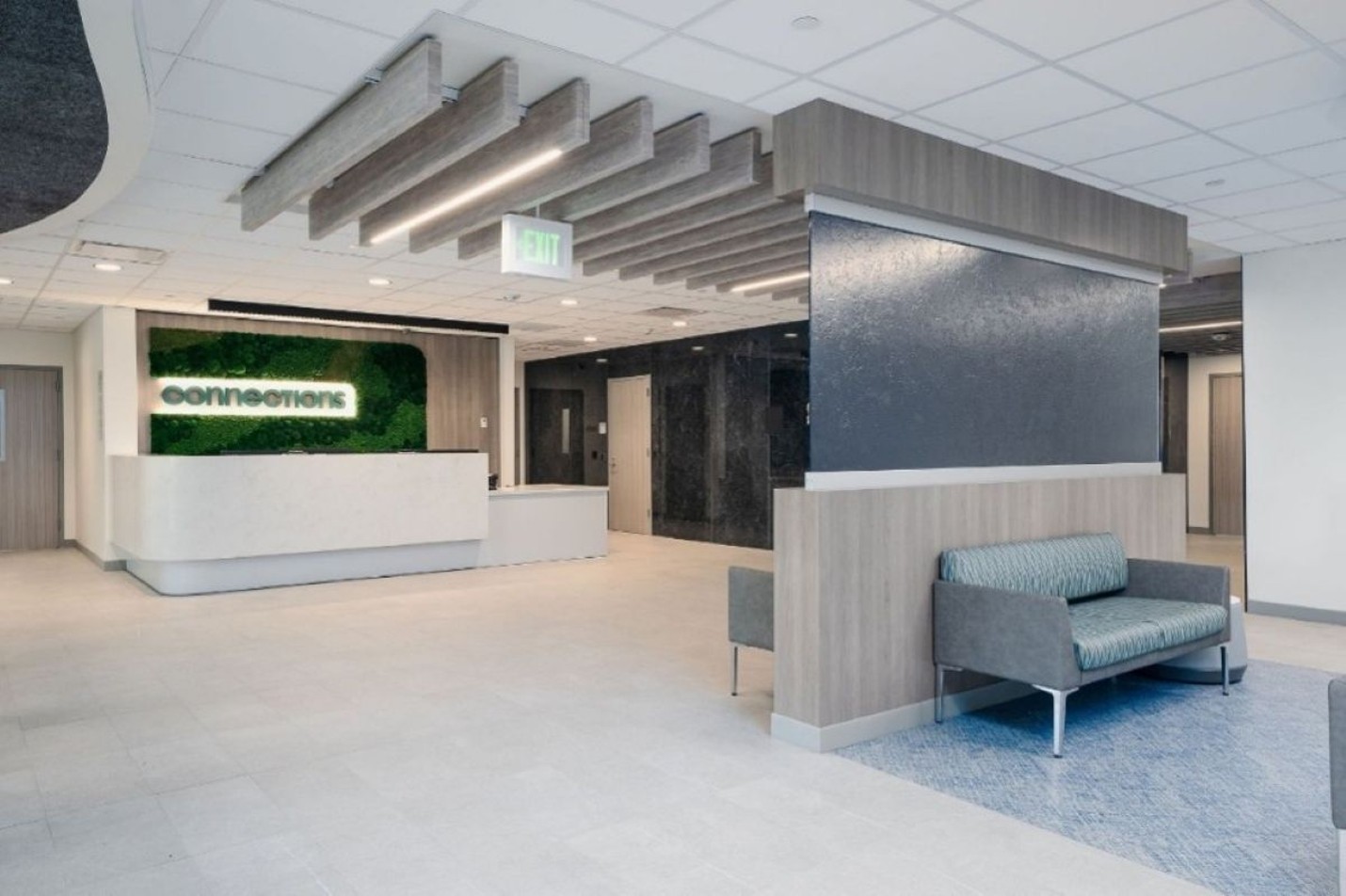
DCHS successfully contracted, arranged funding using both Levy revenue and Medicaid benefits, and supported ongoing operations for the North Regional Crisis Care Center. DCHS regularly engaged community members and first responders via community forums, public communications campaigns, and crisis system partner meetings to increase awareness and understanding of how to access Crisis Care Center services. DCHS actively provides oversight of the center’s operations and performance using continuous quality improvement practices. This ensures the current center delivers services in line with the required clinical best practices and helps inform future Crisis Care Center procurement and implementation.24
Central Regional Crisis Care Center – Seattle, WA
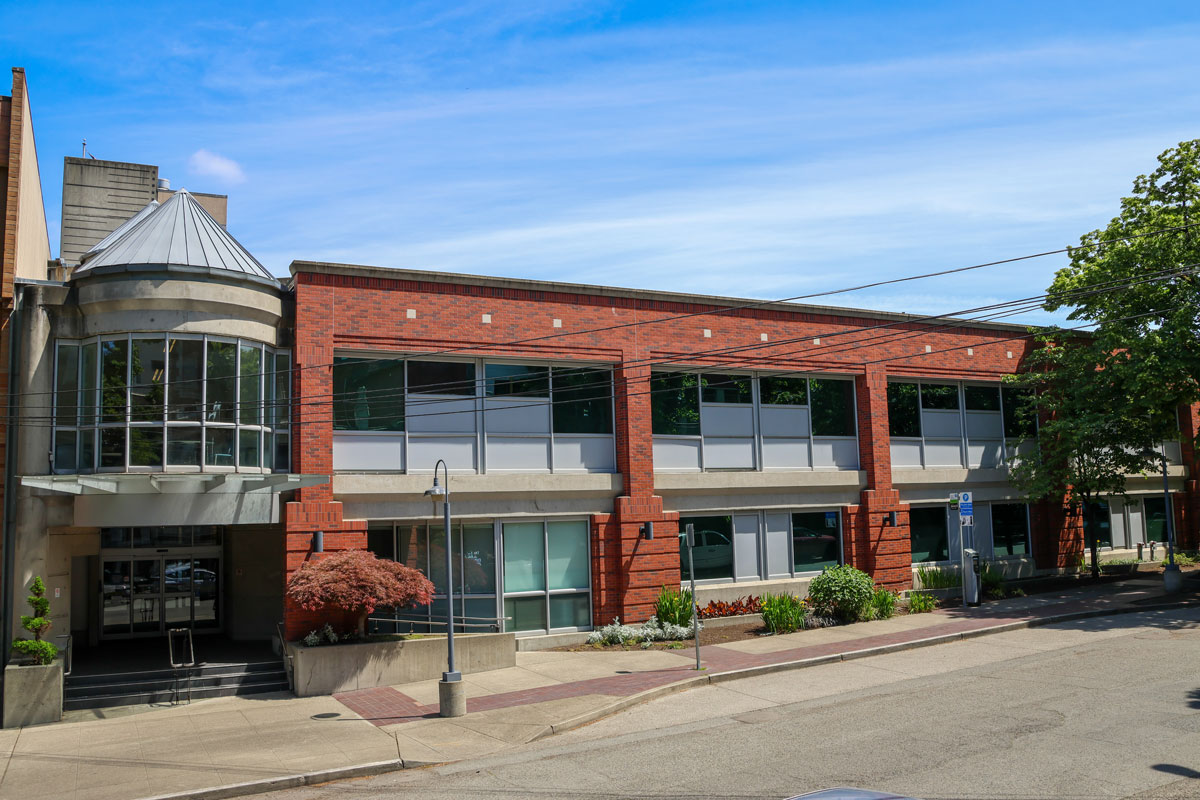
DCHS made significant progress toward opening the Central Regional Crisis Care Center, culminating in the purchase of its future site and selecting the operator, Connections Health Solutions. A crucial component of this work was the robust community engagement DCHS led, hosting nearly 60 community conversations, presentations, walking tours, and other events during the site development process. Through these sessions, DCHS consistently heard that people want a place to go to receive urgent behavioral health care. Engagement with community will continue to be a focus for the Central Regional Crisis Care Center. In late 2025, DCHS began working with the City of Seattle and community members to plan for the Crisis Care Center’s opening. DCHS also finalized a contract with Connections Health Solutions to support their engagement with community partners in advance of the opening.
The County’s purchase of the building on Seattle’s First Hill where the Central Regional Crisis Care Center will be located, provides long-term sustainability for the center. County acquisition also allows necessary planning, permitting, and renovation work to begin more expediently, accelerating the timeline for bringing essential crisis services online.25 The County has secured a property management company to manage the building and has contracted an architecture and engineering firm to complete the interior design. Renovation work is projected to start in late 2026 and be completed in late 2027, pending permit and other regulatory review timelines. The County expects to use some of the additional space at this location for other Levy-related programs, helping create a more connected continuum of care so that people have places to go before, during, and after a crisis.
Figure 3: Image of Central Regional Crisis Care Center site in Seattle, WA
East Regional Crisis Care Center
For the East Regional Crisis Care Center in 2025, DCHS focused on pre-procurement activities. These included meetings with providers interested in serving the East CRZ, plus outreach and engagement with community-based organizations, community groups, and residents. DCHS also engaged with jurisdictions located in the East CRZ, including providing a training co-hosted by the Sound Cities Association.
The County’s focus on flooding response in late 2025 delayed the opening of the Round Two Crisis Care Centers RFP, which focused on proposals to operate the East Regional Crisis Care Center. At the time of this report’s drafting, DCHS was evaluating operator proposals.
South Regional Crisis Care Center
DCHS considered proposals for the South Crisis Care Center in 2025, engaging jurisdictions, providers, and community across the South CRZ to build strong partnerships and provide the educational and technical support necessary to ensure potential operators submitted viable proposals. DCHS announced MultiCare as the operator for the South Regional Crisis Care Center in early 2026.
Youth Crisis Care Center
In 2025, DCHS focused on pre-procurement activities for the Youth Crisis Care Center. DCHS engaged with all youth providers who expressed interest in operating the facility to answer questions and address barriers. DCHS also engaged jurisdictions across King County to help identify potential sites for a Youth Crisis Care Center in anticipation of a youth-focused procurement in 2026.
Post-Crisis Follow Up (PCFU)
PCFU programs are a critical part of the Crisis Care Centers and efforts to break the cycle of repeat crises. In 2025, DCHS released a Request for Information (RFI) and an for providers that have expertise in providing Culturally and Linguistically Appropriate Services (CLAS), with awards announced in early 2026 and services expected to start later that year. PCFU providers and the teams they operate are expected to support the ongoing recovery of people who have recently experienced a behavioral health crisis and received treatment at a Crisis Care Center. PCFU services are designed to be short-term and high-intensity, lasting 30 to 90 days. Teams offer frequent engagement, outreach, support from peers with lived experience navigating crises, and ensure appropriate transitions to community-based services for each individual.
Facility Utilization
The CCC Levy directs DCHS to monitor facility utilization at Crisis Care Centers as part of its continuous quality improvement (CQI) efforts. DCHS requires and supports Crisis Care Center operators to report performance data such as how long community members wait for services, how long community members stay, and how full the centers are to assess how people experience care at each facility. DCHS expects to make data-driven adjustments based on utilization information to help reduce barriers to accessing care and ensure crisis services remain consistently accessible across facilities. If persistent underutilization is identified at a particular center, DCHS will work with the provider to take appropriate action, such as increasing outreach and use of mobile services, to address the needs of the Crisis Care Center.
DCHS is now closely monitoring utilization rates at the North Regional Crisis Care Center, which was ramping up operations in 2025. In calendar year 2025, utilization was in line with DCHS’ expectations for the center. A total of 6,697 unique people were served through 5,425 visits to the three clinics at the North Regional Crisis Care Center (including the behavioral health urgent care, 23-Hour observation, and crisis stabilization units). Utilization is growing as awareness grows, and people become more comfortable getting behavioral health care sooner, before their crisis escalates. In 2025, DCHS hosted monthly community update meetings, placed stories in local media, advertised services inside King County Metro buses, co-hosted educational and awareness building events with Connections Health Solutions, and facilitated partnership between Connections Health Solutions and other regional providers to promote awareness and utilization of the North Regional Crisis Care Center.
Future CCC Levy annual reports are expected to highlight CQI efforts as more performance data becomes available and more Crisis Care Centers open. Utilization rates are a key piece of information that will be monitored closely to ensure that all residents have equitable access to timely, high-quality behavioral health care.
Transportation and Insurance Data
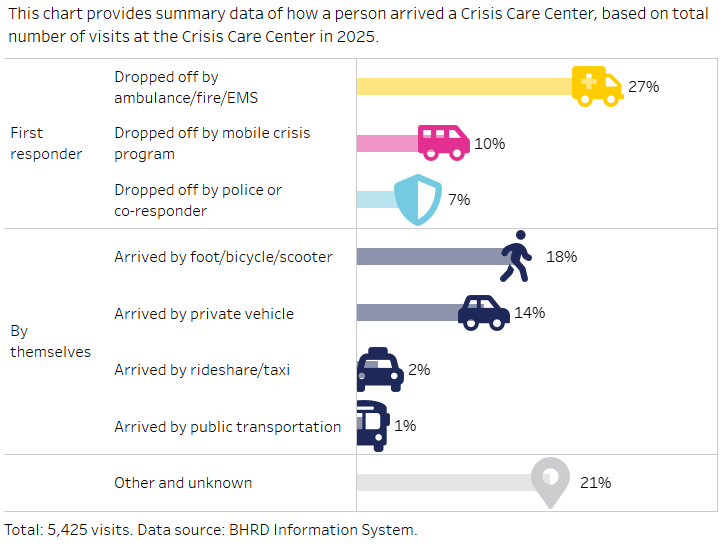
The CCC Levy Implementation Plan requires that annual reports include data on transportation to Crisis Care Centers, as well as data on insurance status for people arriving at a Crisis Care Center. In 2025, people were transported to the North Regional Crisis Care Center in a variety of ways. The most common mode of arrival was by ambulance, fire, or emergency medical services (EMS). Approximately 27 percent of all visits involved individuals being dropped off by one of these first responders. The second most frequent known arrival method was people who brought themselves to the North Regional Crisis Care Center by foot, bicycle, or scooter (18 percent of visits).
When the North Regional Crisis Care Center provider updated its data collection process under the CCC Levy contract in August 2025, transportation data began being recorded in a more detailed way to meet County requirements. As the provider worked to implement this new data collection process, 21 percent of visits in 2025 were categorized as “other/unknown.” Of the “other/unknown” visits, many occurred during the first half of 2025 when data collection was focused more on first responder-initiated visits. As a result, the mode of transportation used by people who referred themselves to the center, or who received transportation from family or friends, was not initially captured in detail. DCHS expects that 2026 data will more fully reflect mode-of-arrival patterns, with a substantially lower “other/unknown” count.
Figure 4: Mode of Transportation
Approximately 50 percent of visits to the North Regional Crisis Care Center involved individuals who reported at arrival that they had Medicaid coverage, including 42 percent of visits where Medicaid was the person’s only coverage. At least 22 percent of visits involved individuals with commercial insurance (as the only coverage or combined with other coverage).26 In 2025, 400 of the 5,425 visits to the North Regional Crisis Care Center, about seven percent, were individuals who were transported by first responders without any documented insurance coverage at the time of their visit.27
Figure 5: Insurance Coverage at Intake
This table summarizes insurance coverage of individuals served by the Crisis Care Center, based on total number of visits at the Crisis Care Center in 2025.
| Type | Percent |
| Medicaid only | 42% |
| Commercial only | 19% |
| Medicare only | 6% |
| Multiple coverage: Medicaid and commercial | 3% |
| Multiple coverage: Medicaid and Medicare | 5% |
| Multiple coverage: Medicare and commercial | < /> |
| Multiple coverage: Medicaid, Medicare, and commercial | < /> |
| No coverage reported | 16% |
| Unknown or Not Available | 8% |
Total: 5,425 visits. Data source: BHRD Information System. Insurance coverage was self-reported at intake when they first arrived at the center and may not reflect how services were ultimately paid. Providers may update coverage information over time as they review and verify eligibility, so counts of "no coverage reported" may change.
In 2025, DCHS advanced the CCC Levy’s Supporting Purpose 1 to restore, expand, and sustain residential treatment capacity. The CCC Levy provides funding for capital development for residential treatment facilities, facility improvements, and facility maintenance. These capital improvements are laying the groundwork for a more resilient and accessible behavioral health system.
Adult Residential Treatment – Capital Facility Development
DCHS awarded two applicants for residential treatment facilities in 2025 totaling $20.9 million, and took steps to bring additional beds online.28
- DCHS awarded $13.0 million to Aristo Healthcare Services, located in Renton, for a 16-bed mental health residential treatment .
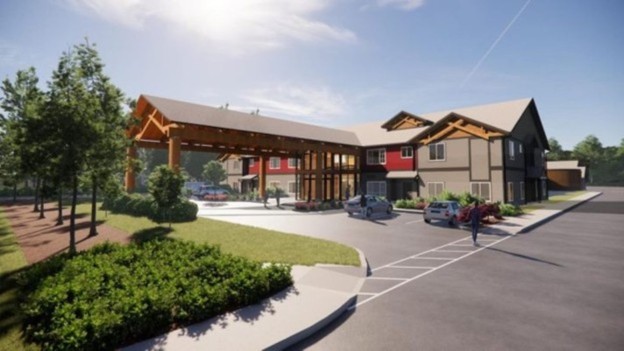
- DCHS awarded $7.9 million to Seattle Indian Health Board for the Thunderbird Treatment Center, located on Vashon Island, to support its 92-bed substance use treatment facility. It is scheduled to open in 2026.
- The 1145 Broadway building acquired for the Central Regional Crisis Care Center has additional square footage that is expected to be used to establish a 16-bed mental health residential treatment facility. This use was identified during the acquisition process in 2025.29
Capital funding projects are generally complex, due to siting processes, construction limitations, and decision-making across multiple levels of government, which can result in extended timelines. In 2026, DCHS plans further contract negotiations for the two 2025 awardees and a new RFP with up to $77 million anticipated for capital funding.
Figure 6: Seattle Indian Health Board’s new Thunderbird Treatment Center will open in 2026.
Adult Residential Treatment – Capital Facility Rehabilitation and Maintenance
Maintaining and improving existing facility capacity is important for keeping residential treatment beds available. In 2025, DCHS awarded $15.0 million in CCC Levy capital funds to support critical improvements across six behavioral health treatment facilities in King County.
- Transitional Resources: Try House (15 beds) - $2.0 million
- Sound Behavioral Services: Keystone (64 beds) - $3.7 million
- Sound Behavioral Services: Stillwater (16 beds) - $4.7 million
- Community House: Cascade Hall (64 beds) - $2.0 million
- Community House: Hilltop Manor (35 beds) - $1.0 million
- Community House: Spring Manor (57 beds) - $1.6 million
These investments are already helping providers move forward with long‑needed repairs, renovations, and expansions that strengthen their ability to serve community members with timely, high‑quality behavioral health care. Examples of these investments include upgraded safety and privacy features for individuals receiving services, more effective and efficient heating and air conditioning systems, and improved office and administrative space for staff.
The CCC Levy invested $12.4 million in two initiatives to strengthen and stabilize the King County community behavioral health workforce in 2025: Career Pathways and Labor-Management Workforce Development Partnerships. The levy also selected an operator to create a new Crisis Training Academy.
Career Pathways
DCHS spent $6.9 million in CCC Levy funds on Career Pathways investments that supported 35 King County community behavioral health agencies to recruit, retain, and increase workforce representativeness.
Overall, 3,686 staff benefited from Career Pathways investments, including 833 staff who obtained or renewed a license. End of year data from participating King County Integrated Care Network (KCICN) agencies indicate that investments are improving workforce recruitment, retention, representation, and wellbeing.30
Consistent with the CCC Levy Implementation Plan requirement that at least 25 percent of Career Pathways funding be used to increase workforce representativeness, this workforce strategy included activities such as diversity, equity, and inclusion-related training, providing internship stipends to attract new workers to community behavioral health, and clinical supervision that enhances the ability of new and existing behavioral health staff to offer culturally and linguistically relevant care.
Student Internship Programs
Twenty-four community behavioral health agencies used funds for clinical internship and practicum programs, which supported 436 interns, including multiple bilingual internships, across various behavioral health workforce concentrations (including but not limited to Mental Health Counseling, Social Work, Substance Use Disorder Professional, Psychology). Agencies provided training and stipends for interns, reducing barriers to professional growth and educational advancement. Providing stipends for interns is a successful recruitment strategy for agencies. At least a quarter of interns accepted a permanent position at their agency at the conclusion of their practicum, demonstrating that paid internship programs are a recruitment pipeline.31
Professional Development
Twenty-three community behavioral health agencies used funds for professional development and training initiatives, including in the areas of diversity, equity, and inclusion, management and leadership development, and clinical skills and approaches. The YMCA received funding for the Y+Heritage program, a free Master’s in Mental Health Counseling program delivered in partnership with Heritage University for community behavioral health clinicians from underrepresented groups. Eighteen clinicians from KCICN agencies graduated with their master’s degree in 2025, and 47 additional clinicians were enrolled at the end of 2025 and are expected to graduate over the next two years.
Clinical Supervision
Thirty community behavioral health agencies received funding to expand clinical supervision across a variety of licensure areas, benefiting 1,377 staff. Free clinical supervision and dedicated time for clinical oversight is supporting behavioral health workforce retention, advancement, and representativeness. Participating agencies reported that guaranteeing consistent clinical supervision hours at no cost to workers enabled them to recruit and retain new substance use disorder and mental health staff and interns. Agencies reported enhanced retention of clinical supervisors, improved clinical supervisor job satisfaction, increased capacity of agencies to deliver clinical supervision for specialty areas and specific license types, and improved ability to deliver culturally and linguistically relevant care.32
Workforce Wellbeing
Twenty-seven community behavioral health agencies requested funding to improve their behavioral health workforce’s wellbeing to support staff retention. Twelve agencies funded structured employee choice reimbursement programs to increase the physical, mental, and emotional health of employees. Selected benefits paid for via these funds included meditation subscriptions, gym memberships, and massage. Other agencies chose to provide staff funds to help cover their medical co-insurance and deductibles, or allocated funds for staff retreats and appreciation.
Labor-Management Workforce Development Partnerships
Per the CCC Levy Implementation Plan, DCHS spent $5.5 million on several labor-management partnership training initiatives that advanced career and educational growth of the behavioral health workforce.33
Behavioral Health Education and Advancement Model (BEAM)34
DCHS contracted with the Healthcare Training Fund to develop and launch BEAM for non-union-represented staff in 2025. A total of 350 staff from 20 agencies accessed professional development benefits including funding for tuition assistance, professional development, conference and travel, and licensure fees in 2025. The professional development reimbursement benefit was the most requested, followed by conference travel and then tuition assistance.
Training Fund Participation
DCHS also reimbursed agencies for participation in the Healthcare Training Fund’s benefit program for SEIU Healthcare 1199NW union-represented staff, which is similar to BEAM. One hundred-one staff accessed funding for tuition assistance, professional development, conference and travel, and license fees in 2025. The onboarding process for agencies took longer than expected, and utilization of benefits is expected to increase in 2026 as more staff become aware of this resource.
Small Agency-Based Contracts for Internal Labor-Management Partnership Programs
Three agencies developed new labor management committees with over 50 percent frontline worker representation to prioritize professional development initiatives. Activities funded included clinical skills training, conferences, management training, and reimbursement for obtaining licensure, credentials, and certifications.
Behavioral Health Apprenticeship and Pathway Development Program
DCHS contracted with the Healthcare Training Fund to expand behavioral health apprenticeship opportunities for KCICN agencies and increase awareness of and interest in behavioral health careers for people not yet in the field. Seven KCICN agencies participated in Levy-funded apprenticeships, enrolling 15 apprentices, of which one-third are Black, Indigenous, and/or People of Color (BIPOC). Four apprentices are enrolled in the Peer Support Specialist apprenticeship, a one-year program, and 11 are enrolled in the Substance Use Disorder Professional apprenticeship, a two-year program. As participating agencies learn to operationalize registered apprenticeships as a new employment and staff training model, they are likely to enroll more apprentices. As a result, the Healthcare Training Fund and is targeting marketing efforts to other agencies including Crisis Care Centers operators as well. To grow interest in behavioral health careers, the Healthcare Training Fund developed a variety of marketing materials and educational resources. For example, it integrated behavioral health curriculum into its Introduction to Healthcare and Apprenticeship Program (IHAP), and 24 participants completed the program.
Crisis Training Academy
In 2025, DCHS awarded $2.5 million to the Behavioral Health Institute at Harborview Medical Center to launch a Crisis Training Academy in 2026. The Crisis Training Academy is designed to provide centralized crisis training for Crisis Care Centers, PCFU teams, and other behavioral health professionals in King County. Behavioral health providers will learn foundational crisis care curriculum, best practices, and how to effectively coordinate with crisis services.
CCC Levy Strategy 4 includes activities to increase the capacity of community-based crisis response programs, reduce overdoses, and support facilities offering substance use disorder services. Progress occurred in 2025 for all Strategy 4 Levy activities.
Embed Behavioral Health Counselors in 911 Call Centers
In 2025, DCHS continued integrating behavioral health counselor resources for 911 call centers. Between April and December 2025, 1,834 calls to 911 were diverted to 988, which is a nationwide three-digit number for people experiencing any type of emotional distress or mental health crisis.35,36 The partnership for this service with Valley Communications (Valley Com) is now operating on a 24/7 basis. Valley Com also communicated with other local Public Safety Answering Points (PSAPs) in 2025 about future integration of behavioral health counselors and anticipates expanding the program participants in 2026. As more PSAPs are brought on board, the program will be able to manage an increase in call volumes.
Expand Mobile Rapid Response Crisis Team (MRRCT) Services
The MRRCT program continued to grow in 2025, with teams responding to help more people in a behavioral health crisis across King County. The program is available 24/7 for any adult in King County who calls 988 requesting a response, regardless of insurance status.
The number of adult teams increased from a total of 17 to 27 teams with investments from the CCC Levy, state, City of Seattle, and MIDD behavioral health sales tax funds. Operated via two contracted service providers, Downtown Emergency Service Center (DESC) and Sound Behavioral Health, MRRCT helps de-escalate, stabilize, engage, and connect people to behavioral health services.37 These community-based services help reduce involvement with costly legal and emergency room systems. In 2025, Crisis Connections, which receives calls from 988 and the Regional Crisis Line, dispatched MRRCT teams 5,676 times. The teams provided services to 3,316 unique individuals. Response times reduced from over one hour in 2024 to an average of 30 minutes by the end of 2025.38
In 2025 MRRCT programs hired the additional staff needed to cover 24/7 shifts. By the end of 2025, programs were operating at full capacity, with program expenditures expected to increase in 2026.
Mobile Response and Stabilization Services (MRSS) for Youth
The MRSS program, operated by the YMCA, expanded in April 2025 and is now serving all children, youth and families in King County utilizing investments from the CCC Levy, state, federal, and local MIDD funds.39 The number of youth teams increased from three to nine on weekdays and two to six on weekends. The program provides 24/7 mobile crisis response, with teams that de‑escalate crises and link young people to needed supports. MRSS does not require a caller to have insurance, and what qualifies as a crisis is defined by the person or family in need, reducing barriers to receiving support. Since April 2025, MRSS teams were dispatched 506 times via Crisis Connections which receives calls from 988 and the Regional Crisis Line. The teams provided services to 445 unique individuals. The program uses a regional model that stages teams across six locations throughout the county to ensure timely responses. MRSS is the successor to the Children’s Crisis Outreach Response System (CCORS) program and launched in April 2025. Due to programmatic transitions, such as hiring timelines and adjustments to the program’s payment model, not all available funds were expended in 2025.
Overdose Prevention Supplies and Resources
Figure 7: Naloxone Vending Machine
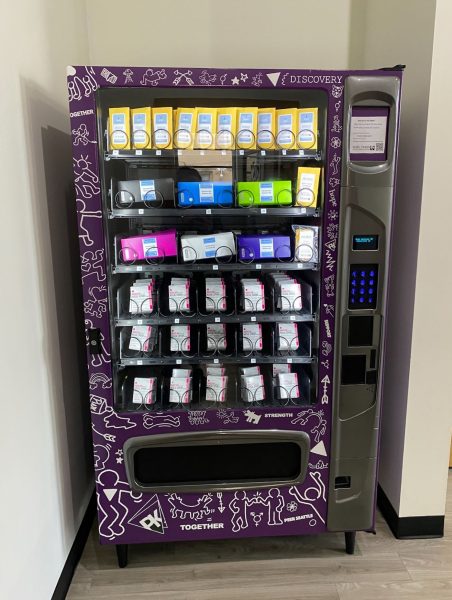
In 2025, the CCC Levy provided funds to help combat the county’s ongoing efforts to reduce opioid overdose deaths, which has seen success with fatal overdoses decreasing 32 percent from 2023 to 2025.40 CCC Levy funds supported five vending machines that dispense free naloxone kits to individuals and community organizations. In 2025, the vending machines distributed over 3,000 kits.41 The machines are located at Peer Seattle, Peer Kent, Maleng Regional Justice Center, YouthCare Orion Center, and Compass Day Center.
Public Health Seattle and King County also installed naloxone distribution boxes at priority sites selected based on high overdose rates and risk factors, including permanent supportive housing, low-income housing, emergency shelters, day centers, and food banks.
Public Health Seattle and King County also started hosting quarterly calls with vending machine site partners, to share best practices, data reports, and lessons learned about what products to offer. Feedback from community members shows the success of the resources made available. "The placement of the Narcan vending machine at our site has been a tremendous success... The impact has been profound—having Narcan readily accessible empowers individuals and families to respond effectively in critical moments, reducing the risk of overdose-related fatalities.”42
Pioneer Square Client Engagement
CCC Levy Strategy 4 funding includes support for the Downtown Emergency Service Center to operate a client engagement team that connects people in the immediate area of the Opioid Recovery and Care Access (ORCA) Center on Third Avenue in Seattle with behavioral health, health care, and social services. The program addresses the needs of individuals accessing services or living outside near drop in and clinical sites. The team builds rapport with individuals, providing education, service orientation, referrals, and de-escalation to address non-emergent needs. In 2025, this funding supported 3,908 instances of DESC staff outreach in the Third Avenue and Pioneer Square area.43
In 2025, Strategy 5 investments funded capacity building and technical assistance contracts with : Advocates for Human Potential, Project Management Advisors, and OAC Services. The agencies used these funds to provide targeted technical assistance to potential Behavioral Health Agencies applying for the levy’s Crisis Care Center and Residential Treatment Facility funding opportunities. These resources increased provider readiness and expanded the pool of competitive applicants by offering support throughout the application process. The contracts can also be used for technical assistance during construction processes in the future. In 2025, eight agencies who were considering applying for these major projects worked with the levy’s contracted consulting agencies.
DCHS also released an RFP offering resources to local jurisdictions for capital facility siting and for Crisis Care Center operators, with awards for those activities anticipated in 2026.
Strategy 6: Evaluation and Performance Measurement Activities
In 2025, DCHS invested in measuring, analyzing, and reporting on the impact of the CCC Levy to inform quality improvement initiatives and for reporting purposes. A plan for a research practice partnership with local academic institutions was developed in 2025 for further evaluation efforts. The Fiscal and Performance Measurement Section, Performance Measurement, below provides additional information.
Strategy 7: Crisis Care Centers Levy Administration
The CCC Levy provides administrative funding to DCHS to manage implementation, accountability to the community, quality assurance and improvement, and to integrate newly funded services into the broader behavioral health service environment. Investments in 2025 aligned with CCC Levy Implementation Plan requirements, including robust community engagement, laying the groundwork for a Trusted Leaders program, and hiring new Levy-funded staff.
Community Engagement
In 2025, DCHS prioritized community engagement. This includes targeted outreach in communities where Crisis Care Centers are sited. DCHS participated in over 100 community engagement activities, ranging from large public events, monthly virtual conversations, and smaller presentations across a range of stakeholders. This engagement across CCC Levy activities informed implementation, helped raise awareness of services and created opportunities to hear input from community members.44 Information obtained through community engagement efforts helps shape educational materials and quality improvement efforts with providers. Throughout 2025, DCHS worked closely with a diverse network of stakeholders across Levy strategies. This included providers, people with lived experience, community‑based organizations, local governments, neighbors and businesses near Crisis Care Centers and others to gather insights, strengthen partnerships, and ground decisions in community priorities and needs. DCHS consistently heard from community members that they support the CCC Levy. They want a robust continuum of crisis services, including the 988 Crisis Line to contact, mobile crisis teams to respond, Crisis Care Centers to go, and post-crisis teams to follow up available for themselves, friends, family, neighbors and people they see in public experiencing a behavioral health crisis.
Figure 8: 2025 Community Engagement Activities
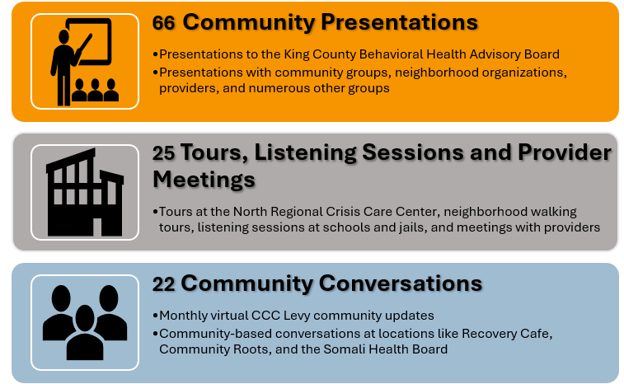
DCHS emphasized interacting with populations experiencing behavioral health inequities and organized larger in-person events with organizations such as the Somali Health Board, NAMI-Eastside, and Indian American Community Services. DCHS translated key CCC Levy materials into nine languages, and the department offered events in Spanish, Somali, and Hindi.45
An example of DCHS’s commitment to community engagement is the department’s facilitation of community involvement during the process to purchase the former Polyclinic building on Broadway on First Hill. This included hosting nearly 60 community conversations, presentations, walking tours, and other events related to the Central Regional Crisis Care Center.46 Not every member of the public supported this purchase, but DCHS heard consistently that people want a place to go to receive urgent behavioral health care. DCHS carried out this work in close coordination with the City of Seattle, which also submitted a conditional letter in support of the purchase.47 King County purchased the building, and by the end of 2025, DCHS was working with the City of Seattle and community members to plan for continued community engagement and pre-opening activities.
DCHS also kept in frequent communication with the Behavioral Health Advisory Board (BHAB), giving updates on CCC Levy activities at monthly meetings, including progress with the North Regional Crisis Care Center.
DCHS employed a variety of communications strategies to keep community and stakeholders informed of the levy’s progress and to raise awareness of crisis services. For example, DCHS published regular electronic newsletters, blog posts, and social media content, created educational materials and info packets, participated in podcasts and traditional media stories. DCHS also placed radio public service announcements, and print ads inside King County Metro Buses, about how to get help in a crisis.
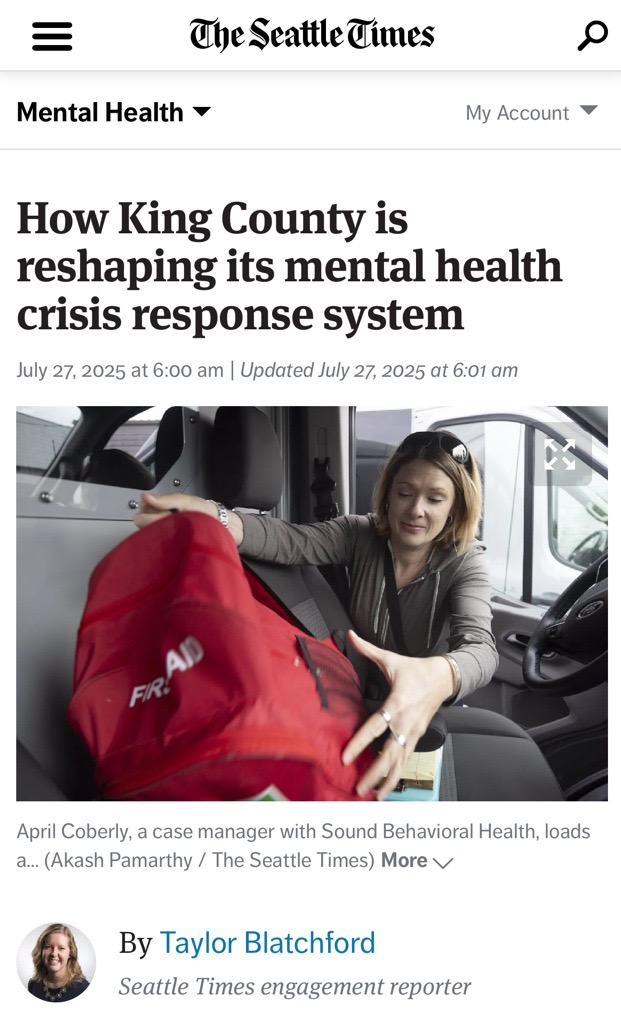
A few illustrative examples of these efforts are provided below.
Figure 9: King County's first-ever crisis care center revolutionizes mental health response | king5.com
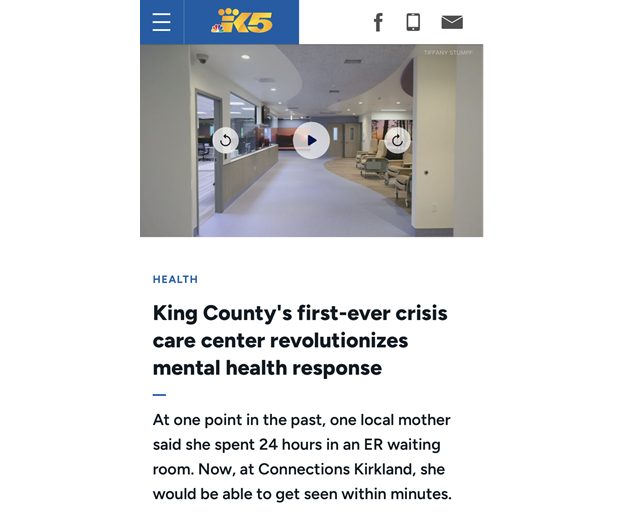
Figure 10: Community Voices: Managing a Mental Crisis with Angela Poe Russell - Converge Media
.png?rev=40258da2750e4817a4f33b3669d73060&hash=2A015A472AF87610A0BEBF8045B5A682)
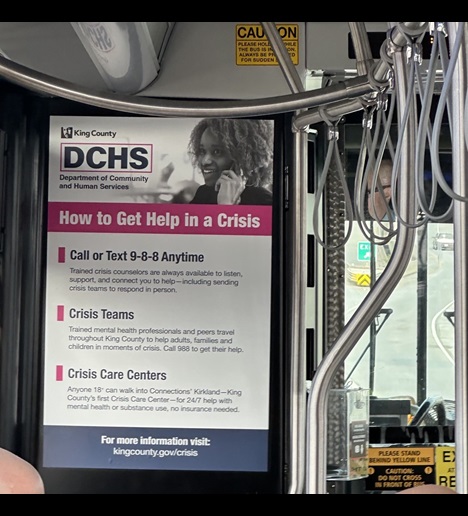
Figure 12: King County’s Journey to Reform Crisis Care - King County Recovery Conversations
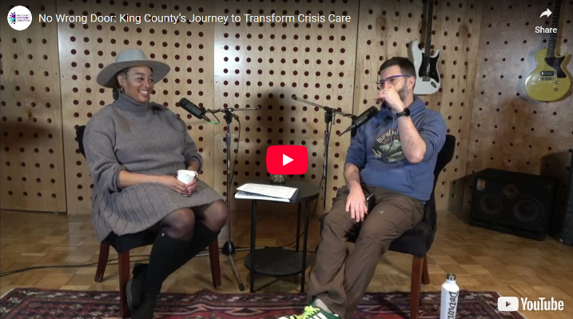
Figure 13: How King County is reshaping its mental health crisis response system | The Seattle Times
Defining Success
The CCC Levy Implementation Plan includes a behavioral health equity framework as part of its quality improvement and accountability requirements. To help achieve this, funding is provided to convene community partners, known as trusted leaders, to help inform quality metrics for the Crisis Care Centers initiative. In 2025, DCHS drafted an RFP for a logistics coordinator to support trusted leaders to help define quality standards and quality improvement activities. The RFP was released in early 2026.48
Care Coordination Platform Capital Information Technology Project
The CCC Levy calls for investment in data systems infrastructure and technology to improve service providers’ ability to coordinate care for people experiencing a behavioral health crisis and to support providers’ and DCHS’s operational and administrative activities. In 2025, DCHS released a Request for Information (RFI) to better understand the landscape of potential vendors, features, capabilities, and costs for a care coordination platform to meet the CCC Levy requirements. This work requires collaboration across County departments and was approved as a capital IT project in the adopted 2026-27 biennial budget.49 The County anticipates releasing an RFP in 2026 for a vendor to build a crisis care coordination platform.
Third Party Consulting and Technical Assistance
The CCC Levy Implementation Plan includes funding for third party consulting and technical assistance to support DCHS implementation activities. In 2025, funding was provided to consultants specializing in legal review, capital project development, procurement strategy, and workforce program implementation. This additional capacity helped advance capital planning efforts for Crisis Care Centers and Residential Treatment Facilities, streamlined procurement processes, ensured projects met regulatory and State Environmental Policy Act (SEPA) requirements, and supported the development of best‑practice frameworks that improved the efficiency and accountability of levy‑funded projects.
Strategy 8: Crisis Care Centers Levy Reserves
In 2025, the CCC Levy maintained a fund reserve consistent with King County’s Comprehensive Financial Management Policies.50 It also maintained Strategy 1 and Strategy 2 reserve requirements to cover ongoing capital maintenance costs of behavioral health facilities.
Intended Changes to Improve Performance
The Crisis Care Centers initiative made progress in 2025, including negotiating contracts and launching services. Since most CCC programs were in the early stages of operation during this first full year of implementation, DCHS focused on ways to identify areas for improved performance. For example, as described in the Accomplishments Section, Facility Utilization, the performance of the North Regional Crisis Care Center is being monitored closely, including through annual beginning in 2026. These program reviews will help refine clinical practices to ensure the Crisis Care Center complies with their contact and meeting community needs. Findings will be used to identify and respond to emerging trends, service gaps, and unmet needs that may influence utilization patterns.
As levy programs are implemented and more data becomes available, DCHS will continue to assess performance and make necessary adjustments to ensure service quality and effectiveness.
Fiscal and Performance Measurement
Actual Financial Expenditures
In 2025, DCHS implemented and refined financial systems and internal capacity needed to oversee the CCC Levy and meet long-term goals. The CCC Levy’s 2025 budget was $122.1 million, while actual spending totaled $64 million. The difference between budgeted amounts and expenditures was primarily due to timelines for capital projects that extend beyond 2025, in two Levy strategies.
Strategy 1, Create and Operate Five Crisis Care Centers, had a budget of $59.9 million in 2025, with $40 million spent during the year. Lower spending in Strategy 1 by $19.9 million compared to original Implementation Plan projections reflected the fact that progress in acquiring and converting the initial Crisis Care Centers had not proceeded as rapidly as originally forecast, meaning capital costs for purchasing the North Regional Crisis Care Center and renovating the Central Regional Crisis Care Center were deferred into future years. It can take 18 months to two years from the date of acquisition of a Crisis Care Center location to complete building and renovations. As work to prepare the Central Regional Crisis Care Center for operations proceeds in 2026 and 2027, and additional future Crisis Care Center locations are identified, the budgeted capital costs for renovation, and conversion will be expended.
Strategy 2, Restore, Expand, and Sustain Residential Treatment Capacity, had a budget of $33.3 million in 2025. Of this, just $1.7 million was expended, but $35.9 million was awarded.51 As discussed above in the Accomplishments Section, Restore, Expand, and Sustain Residential Treatment Capacity, capital activities can face longer timelines for expenditure than initially anticipated due to issues such as siting, construction limitations, and decision-making across multiple levels of government. For example, awarded projects need to go through planning, design, and permitting stages. As more Residential Treatment Facilities come online and capital awardees draw down funds, annual funding is expected to more closely match budgeted amounts.
Financial Expenditures Table
Figure 14: Financial Expenditures in 2025
|
Purpose |
Strategy |
Activity |
2025 CCC Levy Expenditures |
2025 CCC Levy Budget |
|---|---|---|---|---|
|
Crisis Care Centers |
1 – Create and Operate Five Crisis Care Centers |
Central Regional Crisis Care Center |
$20,777,155 |
|
|
Crisis Care Centers |
1 – Create and Operate Five Crisis Care Centers |
North Regional Crisis Care Center |
$19,201,521 |
|
|
Strategy 1 Total Spent: $39,978,676 |
Strategy 1 Total 2025 Budget: |
|||
|
Residential Treatment |
2 – Restore, Expand, and Sustain Treatment Capacity |
Residential Treatment |
$1,679,625 |
|
|
Strategy 2 Total Spent: $1,679,625 |
Strategy 2 Total 2025 Budget: |
|||
|
Community Behavioral Health Workforce |
3 – Strengthen the Community Behavioral Health Workforce |
Apprenticeship |
$2,476,596 |
|
|
Community Behavioral Health Workforce |
3 – Strengthen the Community Behavioral Health Workforce |
Career Pathways |
$6,924,378 |
|
|
Community Behavioral Health Workforce |
3 – Strengthen the Community Behavioral Health Workforce |
Labor Management Partnership Training |
$3,003,999 |
|
|
Strategy 3 Total Spent: $12,404,973 |
Strategy 3 Total 2025 Budget: |
|||
|
Crisis Care Centers |
4 – Early Crisis Response Investments |
911 Diversion |
$1,046,736 |
|
|
Crisis Care Centers |
4 – Early Crisis Response Investments |
Overdose Prevention Supplies and Resources |
$1,116,461 |
|
|
Crisis Care Centers |
4 – Early Crisis Response Investments |
Mobile Rapid Response Crisis Team |
$210,062 |
|
|
Crisis Care Centers |
4 – Early Crisis Response Investments |
Mobile Response and Stabilization Services |
$405,038 |
|
|
Crisis Care Centers |
4 – Early Crisis Response Investments |
Pioneer Square Client Engagement |
$206,730 |
|
|
Strategy 4 Total Spent: $2,985,027 |
Strategy 4 Total 2025 Budget: |
|||
|
Supports All Purposes |
5 – Capacity Building and Technical Assistance |
Capacity Building and Technical Assistance |
$96,902 |
|
|
Strategy 5 Total Spent: $96,902 |
Strategy 5 Total 2025 Budget: |
|||
|
Supports All Purposes |
6. Evaluation and Performance Management |
Evaluation and Performance Measurement |
$806,408 |
|
|
Strategy 6 Total Spent: $806,408 |
Strategy 6 Total 2025 Budget: |
|||
|
Supports All Purposes |
7. CCC Levy Administration |
CCC Levy Administration |
$6,049,033 |
|
|
Strategy 7 Total Spent: $6,049,033 |
Strategy 7 Total 2025 Budget: |
|||
|
Levy Total |
2025 Levy Total Spent: |
2025 Levy Budget Total: |
Assessment of Residential Treatment Financial Plan
The CCC Levy maintains the financial capacity to restore, expand, and sustain mental health residential treatment to 355 beds countywide.55 The financial plan for the levy’s strategy to restore, expand, and sustain residential treatment capacity did not substantively change in 2025, though the timing of some early expenditures shifted slightly to reflect RFP timing.
As described further in the Accomplishments Section, Restore, Expand, and Sustain Residential Treatment Capacity, DCHS awarded capital improvements and maintenance funding in 2025. Consistent with the CCC Levy’s phased procurement strategy, capital development funds will continue to be awarded and expended in future years.
Performance Measurement
In 2025, performance measurement efforts continued building the evaluation and performance measurement framework outlined in the CCC Levy Implementation Plan. DCHS continued partnering with providers in 2025 to establish data collection and performance measures, including with Crisis Care Center operators, mobile crisis service providers, and behavioral health workforce programs. Community input also helped identify measures of success that are important to the community, such as an emphasis on documenting demographic data, including race and ethnicity, to identify potential disparities and to measure equity impacts on the effectiveness of services.56
DCHS will continue refining the performance measurement evaluation framework to meet other requirements in future annual reports, including consulting with cities and the Sound Cities Association about year-over-year comparisons and aligning CCC Levy performance measurement and reporting with other human services initiatives.
Geographic Distribution
Distribution of Expenditures by ZIP Code and Crisis Response Zone
In 2025, CCC Levy investments continued to support the entire county, with some programmatic investments connected to specific facilities or service areas. For example, investments in strengthening the behavioral health workforce, mobile crisis response, and overdose prevention supplies and resources were available to the entire county. For several programs, including establishing a network of regional Crisis Care Centers, DCHS awarded levy funds to projects in specific locations, which provide services to county residents regardless of where they live.
If you're having trouble viewing this visualization, try using Safari or Firefox. For the best experience, view this on a laptop or desktop computer.
Figure 15: Financial Expenditures by Crisis Response Zone, Purpose or Strategy, Levy Activity
A detailed table containing comprehensive geographic distribution data is also available at this link.
Distribution of Individuals Served by ZIP Code and Crisis Response Zone
In 2025, CCC Levy-funded programs served people across the entire county. People who live in ZIP Codes across King County’s four CRZs received levy-funded crisis care in a Crisis Care Center or from mobile crisis services. As a result of one Crisis Care Center being open, the majority of people who accessed levy-funded services in 2025 received care in a Kirkland ZIP Code, where the North Regional Crisis Care Center is located.
Since mobile crisis services are provided throughout the county, ZIP Code data reflects a broader distribution for individuals served.
In addition to ZIP Codes, Figure 16 also provides data on geographic distribution by crisis response zone (CRZ). 6,697 people who live across the four CRZs received Levy-funded crisis care from a Crisis Care Center or mobile crisis services. The majority of these people lived in the Central and South CRZs, which have the largest total population. Likewise, people were able to access levy-funded services in each CRZ, with most people receiving services at the North Regional Crisis Care Center. DCHS expects the number of individuals served to increase, in all areas of the county, as additional levy programs are launched and expanded.
If you're having trouble viewing this visualization, try using Safari or Firefox. For the best experience, view this on a laptop or desktop computer.
Figure 16: Number of People Served in 2025
A detailed table containing comprehensive data on the geographic distribution of individuals served is also available at this link.
Conclusion/Next Actions
In its second year of implementation, the CCC Levy helped more people access crisis care services in King County than ever before. The County contracted and began promoting the first regional Crisis Care Center, awarded critical funding for residential treatment, and expanded mobile crisis response services. Procurements for additional Crisis Care Center operators and investments in the behavioral health workforce in 2025 also advanced the paramount and supporting purposes of the Levy. As DCHS continues to focus on meeting the goals of the CCC Levy Implementation Plan in partnership with providers and community members, the CCC Levy is uniquely and well positioned to continue building and operating a behavioral health crisis system that offers timely, compassionate, and effective care to all residents and that is a key component of the effort to Break the Cycle.
Next Actions:
Key next actions for 2026 are expected to include:
- Awards and contracts for the South, East, and Youth Crisis Care Centers;
- Launch of three PCFU teams providing culturally and linguistically appropriate services;
- New procurements, awards, and expenditures to restore, expand, and sustain residential treatment facilities;
- Maintaining workforce development initiatives through new funding opportunities, and initiating the Crisis Training Academy;
- Continuing investments for community-based crisis response programs, reducing overdoses, and facilities offering substance use disorder services;
- Continued technical assistance and capacity building funding to support providers and jurisdictions siting facilities and responding to procurements;
- Measuring, analyzing, and reporting on the impact of the CCC Levy; and
- Releasing procurement to build a Crisis Care Coordination Platform.
Endnotes
- Ordinance 19572. (2022); King County. (2026). Crisis Care Levies mid-year project implementation status report (File No. 2026-RPT0055). Behavioral Health and Recovery Division. https://kingcounty.legistar.com/LegislationDetail.aspx?ID=5859151&GUID=853F9D4E-37DC-4642-80B5-AE3C3D23ECEC&Options=Advanced&Search=.
- Center for American Progress. (2022, May 26). The behavioral health care affordability problem. https://www.americanprogress.org/article/the-behavioral-health-care-affordability-problem/. Seattle Times. (June 30, 2026). The funding challenge stalling mental health crisis centers across WA. https://www.seattletimes.com/seattle-news/mental-health/the-funding-challenge-stalling-mental-health-crisis-centers-across-wa/.
- King County. (2023). Crisis care centers levy implementation plan 2024-2032. https://mkcclegisearch.kingcounty.gov/LegislationDetail.aspx?ID=6459911&GUID=F1D5851C-A12B-4808-A5A4-E8D167F04FE6.
- King County. (2023). Crisis care centers levy implementation plan 2024-2032. Page 6. https://mkcclegisearch.kingcounty.gov/LegislationDetail.aspx?ID=6459911&GUID=F1D5851C-A12B-4808-A5A4-E8D167F04FE6. As of the drafting of this report, King County has 240 residential treatment beds for mental health conditions in seven facilities, a decrease of 115 beds from 2018 when there were 355 beds. Forthcoming CCC Levy investments are expected to begin to increase this number.
- Residential treatment is a community-based behavioral health treatment option for people who need a higher level of care than outpatient behavioral health services can provide.
- King County Crisis and Commitment Services offers evaluation of people with behavioral health disorders for involuntary detention in psychiatric and secure withdrawal facilities according to Washington law. The law for adults is RCW 71.05. Wash. Rev. Code § 71.05 (2023). https://app.leg.wa.gov/RCW/default.aspx?cite=71.05. For youth 13 through 17 years of age the law is RCW 71.34. Wash. Rev. Code § 71.34 (2023). https://app.leg.wa.gov/RCW/default.aspx?cite=71.34. Crisis and Commitment staff who perform these duties are referred to as Designated Crisis Responders (DCRs). https://kingcounty.gov/en/dept/dchs/human-social-services/behavioral-health-recovery/crisis-services.
- Ordinance 19704 created the crisis care center fund to account for Crisis Care Center Levy proceeds. Ordinance 19704. (2023). https://mkcclegisearch.kingcounty.gov/LegislationDetail.aspx?ID=6378723&GUID=16013671-5A45-4766-BE71-5DD74824BB1B&Options=Advanced&Search=.
- This strategy creates a fund reserve equal to 60 days of budgeted expenditures, less capital expenses, consistent with King County Comprehensive Financial Management Policies (2016) King County. (2016). King County comprehensive financial management policies. https://kingcounty.gov/en/dept/executive-services/about-king-county/business-operations/finance-business-operations/financial-management
- Ordinance 19572. (2022); King County. (2026). Crisis Care Levies mid-year project implementation status report (File No. 2026-RPT0055). Behavioral Health and Recovery Division. https://kingcounty.legistar.com/LegislationDetail.aspx?ID=5859151&GUID=853F9D4E-37DC-4642-80B5-AE3C3D23ECEC&Options=Advanced&Search=; King County. (2023). Crisis care centers levy implementation plan 2024-2032. Page 116-117. https://mkcclegisearch.kingcounty.gov/LegislationDetail.aspx?ID=6459911&GUID=F1D5851C-A12B-4808-A5A4-E8D167F04FE6.
- King County. (2023). Crisis care centers levy implementation plan 2024-2032. Page 116. https://mkcclegisearch.kingcounty.gov/LegislationDetail.aspx?ID=6459911&GUID=F1D5851C-A12B-4808-A5A4-E8D167F04FE66; 2025 was the first year of CCC Levy service activities and will act as a baseline for future years. As a result, comparison data is not available until 2026. However, DCHS is designing fiscal and performance management data systems so that they can be compared year to year. DCHS is also in consultation with Cities and the Sound Cities Association about the CCC Levy and will address this requirement with them for the 2026 Annual Report.
- King County. (2025). Funding opportunities. Department of Community and Human Services. https://kingcounty.gov/en/dept/dchs/human-social-services/funding-opportunities-dchs/funding-opportunities.
- Department of Community and Human Services. (2025, June 20). RFP - Post-Crisis Follow Up by Providers with Expertise in Culturally and Linguistically Appropriate Services (PCFU CLAS). https://www.zoomgrants.com/gprop2.asp?donorid=2209&rfpid=5717.
- Department of Community and Human Services. (2025, September 19). RFP – Residential Treatment Facility Capital Development. https://www.zoomgrants.com/gprop2.asp?donorid=2209&rfpid=5600.
- Department of Community and Human Services. (2025, August 18). RFP – Crisis Training Academy. https://www.zoomgrants.com/gprop2.asp?donorid=2209&rfpid=5758.
- Department of Community and Human Services. (2025, July 25). RFP – Capacity Building and Technical Assistance Funds for Jurisdictions. https://www.zoomgrants.com/gprop2.asp?donorid=2209&rfpid=5718.
- Department of Community and Human Services. (2025, March 14). RFI - Behavioral health crisis care coordination interface. King County. Solicitation Number KC001400.
- Department of Community and Human Services. (n.d.). Internal community engagement tracking data on file with report authors [Unpublished internal data]. King County.
- Ordinance 19572. (2022); King County. (2026). Crisis Care Levies mid-year project implementation status report (File No. 2026-RPT0055). Behavioral Health and Recovery Division. https://kingcounty.legistar.com/LegislationDetail.aspx?ID=5859151&GUID=853F9D4E-37DC-4642-80B5-AE3C3D23ECEC&Options=Advanced&Search=. King County. (2026). Crisis Care Levies mid-year project implementation status report (File No. 2026-RPT0055). Behavioral Health and Recovery Division. https://mkcclegisearch.kingcounty.gov/LegislationDetail.aspx?ID=8045646&GUID=0A13B782-9845-42ED-9B8D-1014EE77323E&Options=Advanced&Search=.
- Connections Health Solutions. (n.d.). Connections Kirkland. https://connectionshs.com/kirkland. The North Regional Crisis Care Center in Kirkland operated under multiple contracts in 2025, but the services to adults were consistent throughout the year. Prior to August 1, 2025, the contract with Kirkland Connections for services was not officially as a Crisis Care Center but provided funding for equivalent services. On August 1, 2025 the contract to officially operate as a CCC Levy Crisis Care Center took effect. The reason for the dual status in 2025 was the result of this being the first Crisis Care Center and the need for contract negotiations. This report includes analytic data for the entirety of 2025 since the services offered were functionally equivalent.
- King County. (2023). Crisis care centers levy implementation plan 2024-2032. Page 39. https://mkcclegisearch.kingcounty.gov/LegislationDetail.aspx?ID=6459911&GUID=F1D5851C-A12B-4808-A5A4-E8D167F04FE6.
- Connections Health Solutions (n.d.). Connections Kirkland. Retrieved July 8, 2026, from https://connectionshs.com/kirkland.
- King County. (n.d.). Crisis care centers dashboard. Retrieved March 25, 2026, from unpublished internal data dashboard.
- [1]King County. (2025). Figure 14: Financial Expenditures in 2025; King County. (2025). CCC Levy Capital Spending Exception Letter. (File No. 2025-RPT0108). Department of Community and Human Services. https://kingcounty.legistar.com/LegislationDetail.aspx?ID=7685665&GUID=8D5B76DD-4484-4E0D-9B4A-A4759104054F&Options=Advanced&Search=.
- King County. (2023). Crisis care centers levy implementation plan 2024-2032. Page 148-149. https://mkcclegisearch.kingcounty.gov/LegislationDetail.aspx?ID=6459911&GUID=F1D5851C-A12B-4808-A5A4-E8D167F04FE6.
- King County. (2025). Broadway Notification Letter. https://mkcclegisearch.kingcounty.gov/View.ashx?M=F&ID=14752143&GUID=7C9892F4-89D6-4F6C-A82D-6EE480FD707F.
- King County. (2023). Crisis care centers levy implementation plan 2024-2032. Page 106. https://mkcclegisearch.kingcounty.gov/LegislationDetail.aspx?ID=6459911&GUID=F1D5851C-A12B-4808-A5A4-E8D167F04FE66; As specified in the Implementation Plan “Due to uncertainty regarding commercial plan rates, the CCC Levy’s financial plan does not assume any commercial plan funding. The actual commercial plan funding will likely be higher than zero dollars.” DCHS has begun submitting claims to commercial insurers and is refining administrative processes so that claims are successfully reimbursed.
- Data notes: Insurance coverage was self-reported at intake and may not reflect how services were ultimately paid. Providers may update coverage information over time as they review and verify eligibility, so counts of visits from uninsured individuals may change.
- Due to flooding in King County in December 2025, the award notices were not sent until January 2026, but the award process was completed in 2025. Department of Community and Human Services. (2026, February 27). King County. (February 27, 2026). King County increases number of residential treatment beds. https://dchsblog.com/2026/02/27/king-county-increases-number-of-residential-treatment-beds/.
- King County. (2025). Broadway Notification Letter. https://mkcclegisearch.kingcounty.gov/View.ashx?M=F&ID=14752143&GUID=7C9892F4-89D6-4F6C-A82D-6EE480FD707F.
- King County. (2026). CCC Levy Career Pathways Notification Letter. (File No.2026-RPT0066). Department of Community and Human Services. Page 4-5. https://mkcclegisearch.kingcounty.gov/LegislationDetail.aspx?ID=8074807&GUID=7F814478-36CD-4108-8EBC-A401A8E26319&Options=Advanced&Search=
- King County. (2026). CCC Levy Career Pathways Notification Letter. (File No.2026-RPT0066). Department of Community and Human Services. Page 6. https://mkcclegisearch.kingcounty.gov/LegislationDetail.aspx?ID=8074807&GUID=7F814478-36CD-4108-8EBC-A401A8E26319&Options=Advanced&Search=6
- King County. (2026). CCC Levy Career Pathways Notification Letter. (File No.2026-RPT0066). Department of Community and Human Services. Page 4-6. https://mkcclegisearch.kingcounty.gov/LegislationDetail.aspx?ID=8074807&GUID=7F814478-36CD-4108-8EBC-A401A8E26319&Options=Advanced&Search=.
- King County. (2023). Crisis care centers levy implementation plan 2024-2032. Page 83. https://mkcclegisearch.kingcounty.gov/LegislationDetail.aspx?ID=6459911&GUID=F1D5851C-A12B-4808-A5A4-E8D167F04FE6.
- BEAM Fund. (n.d.). BEAM: Behavioral Health Equity Activation Method. https://beamfund.org/.
- King County. (n.d.). Crisis care centers dashboard. Retrieved March 25, 2026, from unpublished internal data dashboard. Figure 14: Financial Expenditures in 2025.
- Washington State Department of Health. (2025). 988 Suicide & Crisis Lifeline: Partner Toolkit. https://doh.wa.gov/sites/default/files/2022-07/971056-988LifelinePartnerToolkit.pdf?uid=63520dd975c1d
- Downtown Emergency Service Center. (n.d.). Mobile Crisis Team. https://www.desc.org/what-we-do/crisis-response/mobile-crisis-team/; Sound. (n.d.). Mobile Rapid Response Crisis Teams. https://www.sound.health/tertiary-services/mobile-rapid-response-crisis-teams.
- Department of Community and Human Services. (n.d.). Internal data – PHP96 (unpublished internal data). King County.
- YMCA of Greater Seattle. (n.d.). Crisis support: Social Impact Center. https://www.seattleymca.org/social-impact-center/youth-young-adults/crisis-support. Program formerly known as Children’s Crisis Outreach Response System (CCORS)
- Department of Community and Human Services. (2026, March 10). Update on King County’s response to the opioid overdose crisis. DCHS Blog. https://dchsblog.com/2026/03/10/update-on-king-countys-response-to-the-opioid-overdose-crisis/
- Public Health Seattle and King County. (2026, May 12). Internal data – PHSKC on file with report authors [Unpublished internal data]. King County.
- Public Health Seattle and King County (n.d.) Internal Vendor Feedback Form – Peer Kent on file with report authors (Unpublished).
- This program serves people who are not required to share personally identifiable information, so it is not possible to identify the number of unique individuals served
- Department of Community and Human Services. (n.d.). Internal community engagement tracking data on file with report authors. (Unpublished internal data). King County.
- King County categorizes languages for translation into three tiers – first tier (required) – Spanish; second tier (recommended) – Vietnamese, Somali, Russian, Chinese, Korean, Amharic, Arabic, and Ukrainian; third tier (encouraged) – Tagalog, Punjabi, Tigrinya, Burmese, Nepali, Cambodian, Farsi, Japanese, Hindi, Oromo, Samoan, https://cdn.kingcounty.gov/-/media/king-county/depts/executive-services/policies/documents/inf-14-2-aeo-appendix-c.pdf?la=en&rev=440f019abee6495e92dbacfac63d3062&hash=7C13AC6EAA97FFEE44E80FB4F5465535.
- Department of Community and Human Services. (2025, October 1). Listening to local voices: Community engagement for the Seattle Crisis Care Center location. DCHS Blog. https://dchsblog.com/2025/10/01/listening-to-local-voices-community-engagement-for-the-seattle-crisis-care-center-location/.
- City of Seattle. (2025, August). Letter from Mayor’s Office regarding Crisis Care Center location. https://harrell.seattle.gov/wp-content/uploads/sites/23/2025/08/COS-CCC-Letter.pdf.
- King County. (2026). New RFP for a Logistics Coordinator to Create a Trusted Leaders Network for the Crisis Care Centers Initiative. https://dchsblog.com/2026/03/05/new-rfp-for-a-logistics-coordinator-to-create-a-trusted-leaders-network-for-the-crisis-care-centers-initiative/.
- King County. (2025). Ordinance that adopts the 2026-2027 Biennial Budget. Enactment # 20023. https://mkcclegisearch.kingcounty.gov/LegislationDetail.aspx?ID=7680373&GUID=B4E9E09C-A982-4A8C-A0DA-6CC195D69EE0&Options=Advanced&Search=.
- King County. (2023). Crisis care centers levy implementation plan 2024-2032. Page 101. https://mkcclegisearch.kingcounty.gov/LegislationDetail.aspx?ID=6459911&GUID=F1D5851C-A12B-4808-A5A4-E8D167F04FE6.
- Awarded amounts for Strategy 2 exceeded the 2025 budgeted amount because there was additional funding available from unawarded 2024 CCC Levy Strategy 2 dollars.
- Higher 2025 spending was supported by underspend from Strategy 3 in 2024 that was carried forward into 2025, consistent with the Mental Illness and Drug Dependency (MIDD) implementation plan.
- Not all available Strategy 4 funds were expended in 2025 due to programmatic transitions, such as hiring timelines. Expenditures are expected to increase in 2026.
- Not all Strategy 5 funds were spent in 2025 because the most of these resources are expected to support local jurisdictions with capital facility siting in future years of the Levy.
- King County. (2023). Crisis care centers levy implementation plan 2024-2032. Page 6. https://mkcclegisearch.kingcounty.gov/LegislationDetail.aspx?ID=6459911&GUID=F1D5851C-A12B-4808-A5A4-E8D167F04FE6. As of the drafting of this report, King County has 240 residential treatment beds for mental health conditions in seven facilities, a decrease of 115 beds from 2018 when there were 355 beds.
- King County. (2023). Crisis care centers levy implementation plan 2024-2032. Page 110. https://mkcclegisearch.kingcounty.gov/LegislationDetail.aspx?ID=6459911&GUID=F1D5851C-A12B-4808-A5A4-E8D167F04FE6.