
 Translate
Climate action
As the largest public transportation provider in the Puget Sound region, Metro plays a key role in reducing the number of single car trips and advancing countywide goals to reduce GHG (greenhouse gas) emissions by 80% by 2050, compared to 2007.
In 2022, the FTA named Metro the most equitable agency in tackling climate change. Climate change threatens the health of our community, our environment and our economy. At Metro, we are working to equitably reduce climate pollution with both the services we provide and how we operate.
Transit as a climate solution
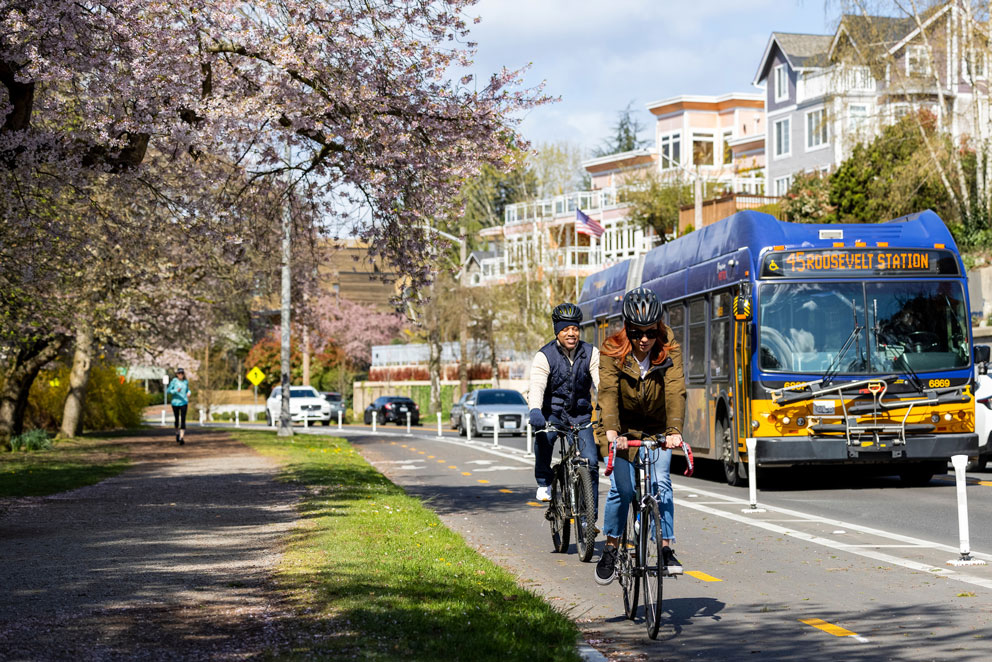
Investments in frequent and reliable service, supported by proper land use, are one of the most cost-effective ways to significantly reduce GHG emissions. Metro helps reduce GHG emissions by improving mobility options, reducing vehicle miles traveled and organizing more efficient land use. These actions can help reduce pollution, improve public health and enhance our quality of life.
Metro’s service guidelines emphasize equity, productivity and land use in identifying areas for increased transit service. Our Transit-Oriented Communities Program creates sustainable communities that reduce the need to drive and increase access to affordable housing. Investments in transit service that carries many and runs often—matched with equitable land use—offer the greatest potential for emissions reductions, supporting the goals outlined in the King County Strategic Climate Action Plan.
2025 sustainability highlights
Added more than 60 zero-emission vehicles and 120 electric vehicle chargers to reduce air pollution from Metro vehicles.
Hit the 2-million-mile mark for zero-emission miles traveled by our battery electric buses (since 2022).

Added bus and water taxi service with more evening and weekend service to help people get where they need to go without a car.
Transitioned to renewable diesel for all our hybrid electric buses, reducing air pollution while we work to convert our bus fleet to 100% zero-emission vehicles.

Completed energy audits and upgrades at our bus bases to lower total energy use by approximately 19% compared to 2014, saving over $860,000 in annual energy costs.
Provided financial incentives for more than 10,000 qualifying trips during the Bike & Scoot to Transit pilot program to improve first/last mile access for people who connect to transit hubs.
Sustainable operations
King County’s Strategic Climate Action Plan sets a goal to reduce GHG emissions from county operations by 80% by 2030, compared to 2007. King County Metro plays an important role in meeting that goal as we are responsible for almost half of emissions from county operations, mostly due to fuel and energy use for our vehicle fleet and associated transit facilities.
Metro is actively transitioning towards a 100% zero-emissions fleet as early as 2035. The "trackless trolleys," which are fueled by electricity have been in operation for over 80 years, are a major component of our zero-emission fleet.
We retired our last diesel bus in 2020 and are expanding our fleet of battery-electric buses to go with the electric trolleys and our current diesel-electric hybrid vehicles. We are opening a new 100% zero emissions fleet bus base, investing in battery electric buses, and upgrading infrastructure and software to support operations. We are also working to transition our non-bus fleet to zero emissions, including Access Paratransit, rideshare, demand response, and decarbonizing our water taxi operations, furthering our commitment to reducing air and noise pollution in support of a healthier King County.
Metro is working to reduce total energy use and transition to low-carbon buildings by eliminating fossil fuels used to operate our facilities. Current activities include:
- Conducting energy audits of our bus bases with implementation of recommended, cost-effective, energy efficiency measures.
- Developing a fossil-fuel elimination plan to chart our path to achieving an 80% fossil fuel reduction by 2050, compared to 2014.
- Benchmarking our facilities and closely tracking our progress toward both near-term and far-reaching energy goals.
- Replacing aging fossil-fuel HVAC systems with high efficiency electric systems.
All capital projects at Metro are subject to King County’s Green Building Ordinance and Strategic Climate Action Plan which requires projects strive for Platinum certification from LEED, Envision, or other third–party certification. The King County Sustainable Infrastructure Scorecard is used for projects that do not meet the minimum program requirements for third-party certification. In 2024, the RapidRide H Line earned the Envision Platinum award for comprehensive equity and sustainability improvements and the RapidRide I Line is on track to achieve this certification at completion.
Metro is committed to advancing green career paths by training current employees and recruiting community members who are most impacted by climate change and economic and social inequities. This initiative supports Metro’s transition to a zero-emission fleet and the expansion of Link light rail.
Learn more about Green Jobs and community eventsPreparing for climate change impacts
In 2022, Metro completed a study to assess climate risks that could affect our assets, operations and service. The most significant areas of impact for Metro are:
- High temperature and air quality impacts on Metro riders, outdoor workers and our electrical infrastructure.
- River and surface flooding impacts on bases and other assets that can damage Metro infrastructure and disrupt or delay service.
- Coastal flooding and sea level rise impacts on bases and other assets, particularly for service operations south of downtown Seattle in the Duwamish River basin.
Metro is working to incorporate these findings into our facility and asset design process and operations. By planning for climate change impacts and implementing adaptation strategies now, we can continue to provide reliable services and contribute to healthy, sustainable communities for all of us.
Publications
King County Strategic Climate Action Plan
County goals, strategies, and priority actions to reduce GHG emissions, create sustainable and resilient frontline communities, and prepare our communities and infrastructure for the impacts of climate change.
Metro's Long Game
Metro’s blueprint to leverage the power of public transit to create a mobility system that advances equity by serving underserved communities, providing new economic opportunities in those neighborhoods, and combating climate change.