
 Translate
Schedule and community questions
Find details about the Sammamish Plateau Diversion project schedule. You can also read common questions and answers about the project.
Project schedule
Below is a description of each step of this capital improvement project. We will keep you up to date as we move forward and provide schedules and duration for each phase.
-
Pre-Design (completed)
The project team conducts research and analysis to identify a corridor for the new wastewater pipe within the larger project area.
-
Early Design (current)
The project team refines the pipe location within the corridor. Field work, consultations, and outreach continue to inform decisions. The team shares the pipe location and next steps with the community, interested people and groups, jurisdictions, and agencies. This phase begins in summer 2026 and is expected to take about 18 months.
-
Final Design
The project team identifies construction methods and continues refining the design. Outreach continues. Permitting and environmental review take place with public comment periods.
-
Construction
During construction, a contractor builds the project according to the design. Our Construction Management team oversees the contractor. Our Community Services team supports project neighbors, area users, and visitors, answering questions and addressing concerns and complaints.
-
Operations
The new pipe is tested and begins operation. Periodic inspection and maintenance are scheduled. Restored landscapes are monitored and maintained. Community Services provides information about maintenance and contact information for neighbors.
Community questions
King County’s Sammamish Plateau Diversion project will add needed wastewater capacity in the Lake Sammamish area. In early 2026, the project team identified a project corridor for new wastewater pipes and support structures. The project is moving into the early design phase. In this phase, the team will refine facility locations and identify potential construction methods. Early design is expected to last about a year and a half.
On this page, you will find questions we have heard from the community.
The project team welcomes your questions, input, and information you want to share with us. We will continue to update this webpage as we hear more.
You will find background information about the project here.
Do you have a question that isn't answered here? Reach out to the project's Community Services team: Email SammamishPlateauDiversionProject@kingcounty.gov or call (425) 537-7216.
The project corridor extends for about four miles and is mostly on East Lake Sammamish Parkway Northeast. The corridor includes a section on Northeast Inglewood Hill Road between the parkway and around 211th Avenue Northeast in Sammamish. It also includes a portion on the East Lake Sammamish Trail near Northeast 65th Street in Redmond. This is where the new pipe will connect to King County's existing Northeast Lake Sammamish Interceptor.
More work to finalize the pipe’s exact location will occur in early design over the next 18 months. During early design, we need to carefully survey what is underground and along the corridor. We know there are other utilities. We will need to do more work to evaluate soil and groundwater conditions. Construction methods also influence where pipes are installed and what impacts we expect.
This evaluation period is a great time for people to engage with the project. If you live, work, recreate, or commute in this area, please share your questions and comments. We share everyone’s input with the project team and track your questions and concerns. We will report back to the community when we have more information. We share how we considered your input during design.
The project team evaluated a number of local factors and features in the project area. Based on our evaluation, the team identified a corridor mostly following East Lake Sammamish Parkway Northeast to build and operate a new pipe.
King County always performs thorough planning before selecting a pipe corridor. On this project the project team has been researching and evaluating the project area to find the best corridor for a new pipe since 2023. This corridor needed to connect from the local sewer system in the south to the County’s existing sewer system in Redmond.
The project team identified challenges and considerations that inform decisions. The northeast Lake Sammamish project area is a busy area with features found in many populated Puget Sound shoreline areas. This includes:
- Steep, forested slopes
- Many streams and a lake
- A busy roadway and trail
- Extensive development with many homes and businesses.
These features create challenges for building and operating new wastewater facilities. Some considerations for new wastewater facilities include:
- Elevation changes often require air relief and odor control at high points.
- Winding streets mean more curves and bends in the pipe. This creates potential for solids buildup, which can cause odors and capacity issues.
- Moving flows uphill against gravity can require pump or lift stations.
- Forested slopes are considered critical areas. This presents special challenges to design, permitting, construction, and restoration.
- Environmental permitting requires agencies to rule out land locations before considering in-water locations.
- Based on the development and features in the area, any corridor in the project area would involve traffic impacts during construction.
The project corridor extends for about four miles and is mostly on East Lake Sammamish Parkway Northeast. The corridor includes a section on Northeast Inglewood Hill Road between the parkway and around 211th Avenue Northeast in Sammamish. It also includes a portion on the East Lake Sammamish Trail near Northeast 65th Street in Redmond. This is where the new pipe will connect to King County's existing Northeast Lake Sammamish Interceptor.
No, the project cannot combine the new pipe with the existing pipes in the street. King County’s wastewater pipes run next to many local pipes throughout our service area. The County's regional lines connect with local lines at designated points.
King County code guides policies and actions for the Wastewater Treatment Division. County code prohibits private connections to the sewer system with few exceptions. Code restricts local connections to designated structures. Those connections must allow accurate metering and sampling.
Northeast Sammamish Sewer and Water District owns and operates a pipe in the project corridor. This pipe collects wastewater from more than 50 private connections along East Lake Sammamish Parkway. These private sewers represent uncontrolled connections and must be connected to the Northeast Sammamish Sewer and Water District pipe. Private sewers are not allowed to connect to the County’s new pipe. It is not feasible to combine local and regional flows in these circumstances.
There is an existing sewer pipe that runs along East Lake Sammamish Parkway. In the project corridor, this pipe is owned and operated by the Northeast Sammamish Water and Sewer District, a local sewer agency. This pipe will continue to collect wastewater from area homes and businesses. It will continue to send flows to the County’s Northeast Lake Sammamish Interceptor in Redmond and then on to South Treatment Plant in Renton for cleaning.
During design, King County’s project team will consider the location of existing pipes in the project corridor when determining where to place the new pipe or pipes.
The new King County pipe will collect wastewater flows from the Sammamish Plateau Water and Sewer District. These flows currently travel south to the County’s Issaquah Interceptor. In the future, those flows will travel north in the County’s new pipe. The new pipe will connect to the County’s existing Northeast Lake Sammamish Interceptor in Redmond.
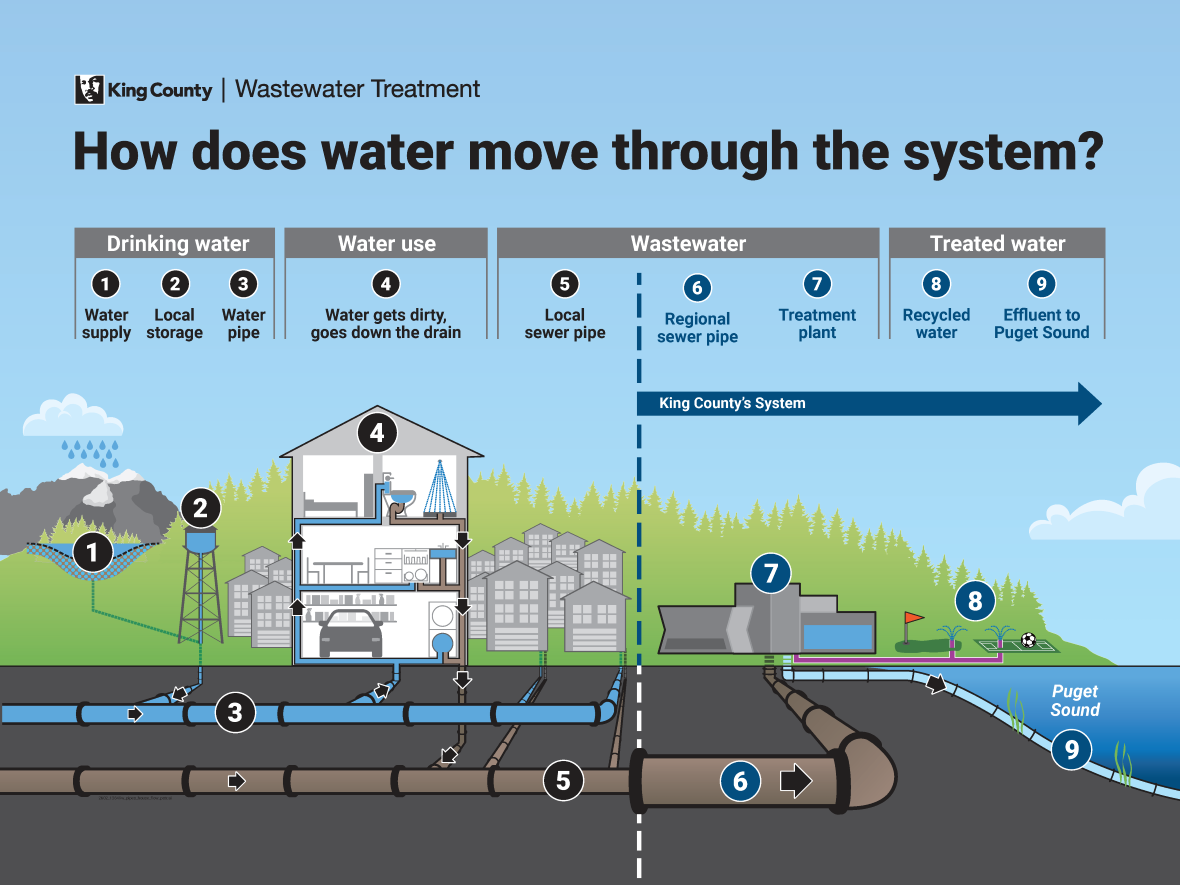
As a regional wastewater treatment provider, King County’s pipes connect to local sewer district pipes. Local sewer systems provide service directly to private properties.
You can see how the local and regional systems work together in the graphic below. This graphic illustrates both the drinking water and wastewater systems; the wastewater system is shown in brown. Wastewater travels from building side sewers to the local sewer pipe and then travels to the regional sewer pipe and wastewater treatment plant (owned and operated by King County). The treated wastewater is discharged or recycled.
People with streams on or near their property have pointed this out to us. They have shared information about stream locations and stream behavior in different conditions.
The maps in the project’s online open house use King County stream data that is currently available. Available data may be out of date or inaccurate. This is especially true for creeks and streams. They may find new paths during flood events or naturally over time. Streams may also have been mapped prior to development in the area.
During the design phase, our project team will make sure we have current, accurate information. This means we will need to assess streams and other features on site. This field research will help inform project design.
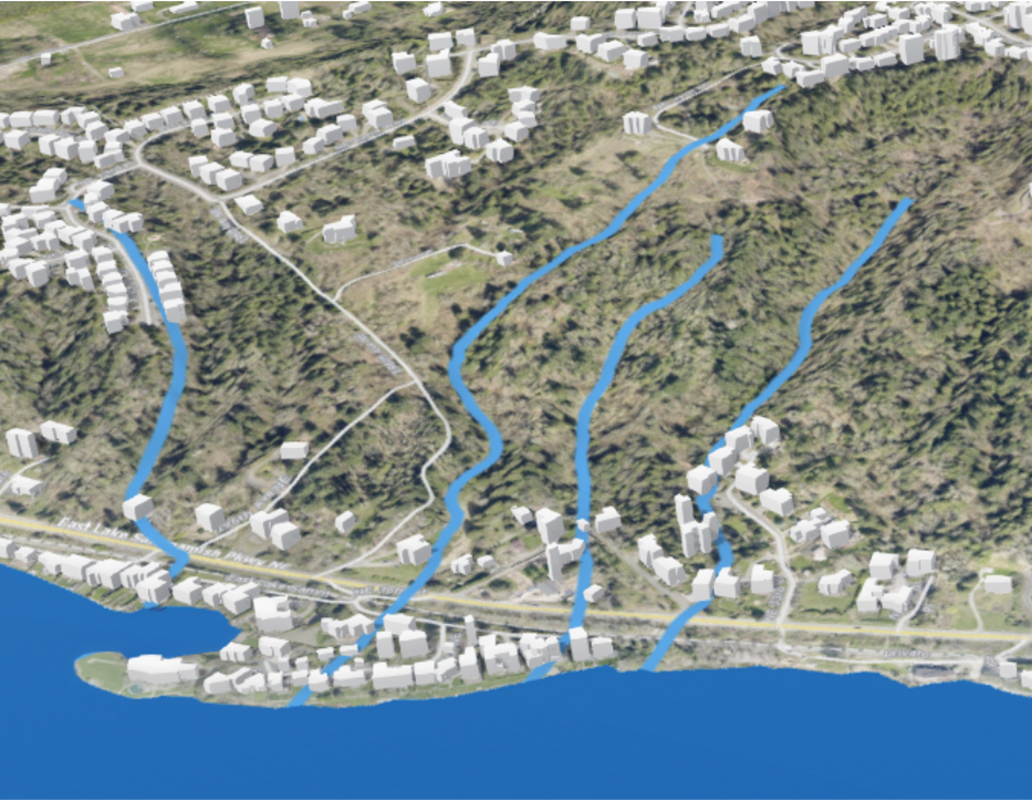
This 3-dimensional map shows streams as blue lines. The streams flow down a steep, forested hillside. They cross under East Lake Sammamish Parkway and flow into Lake Sammamish.
Community suggestions help King County project teams identify opportunities and reduce impacts.
We encourage all interested people to share information and suggestions with the project team early in the project. Our team has been collecting community input through surveys and communications since 2023.
During early design, the project team will identify pipe locations and construction methods. This is a great time to share local information, concerns, and suggestions. We document all community input and share this information with the project team. Community input informs design.
While the project team can’t guarantee we can act on all suggestions, we will share how we’ve considered community feedback.
The project team will do more work to understand exactly where the new pipe will go. You can expect to see more field work, survey work, and crews around the project corridor. We will provide advance notice about this work, including to our project's email list serv and on our project website.
By the end of early design, the project team will have a better idea of the final location of the new pipe or pipes, construction methods, and materials to use to build it. The early design phase begins in summer 2026 and is expected to take about 18 months.
We want to continue hearing from you! There are multiple ways to continue to participate and share your thoughts in this next phase of the project:
- Take the survey in our Online Open House (available in seven languages)
- Request a briefing with your community or group, or share your thoughts with us individually.
- Reach out to us by phone: (425) 537-7216
- Send an email: SammamishPlateauDiversionProject@kingcounty.gov
- Talk to us at a community event! Visit our project webpage and sign up for our email list to learn about upcoming community events we’ll attend.
Everyone who uses the sewer system helps pay for King County's projects. People pay monthly bills to their local sewer agency. Part of each of these bills goes to King County to help build and run the regional sewer system.
We plan ahead for projects, sometimes for years, to help distribute the cost. This means people are not charged extra when we build a project in their neighborhood.
We also use grants, loans, and operating funds to pay for projects. We work hard to balance these funding sources.
People who use septic do not pay a monthly sewer bill.
To learn more, visit our Investing in Clean Water website.